I'll be honest, before I built Touchstone Digital Solutions, I didn't think much about how schools manage their records. It was something I only considered later. My record-keeping strategy was essentially: if someone remembered it, it happened, but now I embrace digital transformation. Turns out, schools cannot operate on that system without proper record management systems.
Running Touchstone, though, and working closely with private schools, universities, and educational institutions across the country, I've seen firsthand how much is at stake when a school's records are a mess. And not just the administrative stuff, we're talking about decades of alumni achievements, donor histories, championship records, and institutional identity sitting in filing cabinets no one's opened since 2009.
Digital record keeping in education isn't just an IT upgrade. For private schools especially, it's a compliance requirement, a reputation issue, and frankly, a missed storytelling opportunity all rolled into one.
Here's the guide I wish someone had handed to school administrators five years ago.
What Digital Student Records Management Actually Covers
Most people hear "digital records" and think of grades and transcripts. That's just the start. Digital record keeping in education spans two core systems that every school needs to understand:
| System | What It Manages |
| Student Information System (SIS) | Enrollment, attendance, grades, transcripts, billing, compliance reporting |
| Learning Management System (LMS) | Course materials, assignments, quiz results, and learning progress should all be stored in digital formats. |
Beyond those two, schools also keep administrative records, like staff files , accreditation documents, financial records, plus they maintain health and safeguarding records. They even store donor and alumni histories in their own way. The SIS and LMS end up working together, one captures the official academic past, the other deals with day to day classroom activity.
For private high schools and universities the stakes are actually higher. You are recruiting scholar athletes and future leaders , at the same time. You are also dealing with the big picture where you’re competing for top faculty. Donors and alumni are watching. Your records system isn't just operational infrastructure, it's part of your reputation.
FERPA Compliance and School Record Keeping Frameworks Private Schools Can't Ignore
This is where most schools either get serious or get burned.
FERPA is basically the baseline in the United States. It keeps the confidentiality of student education records, and if there is non compliance there is a real chance of losing federal funding. Nobody really wants to end up in that discussion, especially not with a board of trustees.
GDPR kicks in if your institution has European students or if your data processing is touching EU residents, even a small amount. It asks for explicit consent for the handling of personally identifiable info, and the idea of “personally identifiable” is wider than most schools anticipate . In practice, there can be more situations than you would guess at first glance.
Beyond federal law, state regulations mandate specific retention periods and disposal procedures that vary by jurisdiction. Here's a hard rule: some records you keep forever. No exceptions.
Records to retain permanently:
- Student enrollment and attendance histories
- Personnel files for staff working with minors
- Insurance policies and risk management documentation should be scanned and stored in digital formats.
- Institutional accreditation and licensing records
- Governance policies and procedures
One stat worth sitting with: up to 40% of compliance issues in schools are tied directly to staff not understanding their legal obligations. Training isn't a line item you cut when budgets get tight. It's part of the compliance system itself.
How to Implement Education Records Digitization Without the Chaos
Buying software isn't a strategy. I've seen schools drop significant money on a platform and still have a record disaster six months later because nobody defined the process first. Here's what digital records management best practices This is what a streamlined record management system should actually look like when done right:
Define policies before go-live. Who creates, accesses, updates, archives, and deletes each record type? Document it before anyone touches the digital system.
Build a real indexing structure. Metadata and tagging make records retrievable in seconds, not buried in a folder hierarchy no one remembers creating.
Implement role-based access. Not everyone needs visibility into everything. Limit access, log changes, and audit regularly.
Encrypt everything in digital formats. In transit and at rest. This is the floor of digital transformation, not a premium feature.
Schedule regular cloud backups. Regular cloud backups, both on site and off site. Paper files don’t live through floods, cloud backups do.
Train staff continuously. Keep training staff, again and again. Weak digital literacy among administrators and teachers is one of the most repeatedly mentioned obstacles to adoption across schools worldwide.
Set retention schedules. Flag records for archiving or disposal on a regulatory timeline. Don't let your database become a digital attic; instead, implement effective document management.
Beyond Administrative Files: Digitizing Your School's Institutional Legacy
Here's where I get to talk about what we actually do at Touchstone; because it's directly relevant and most schools genuinely haven't thought about this angle.
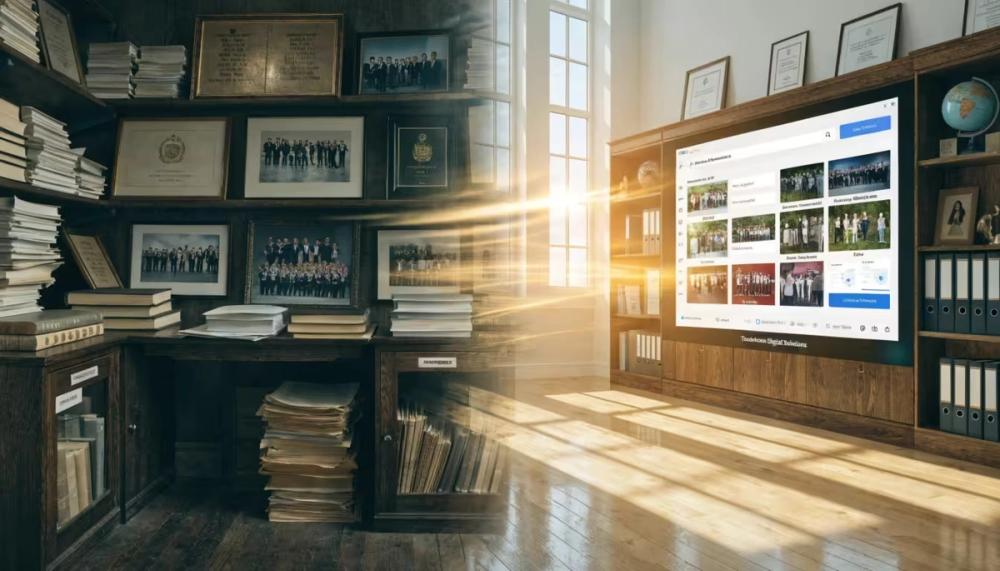
Administrative records are one category of school history. But your institution's identity, its championship teams, its distinguished alumni, its donor legacy, its decades of traditions, that's another category entirely. And it's one that most schools are still managing the way my college football coach managed my highlight reel: inconsistently, partially, and with a lot of stuff lost to time.
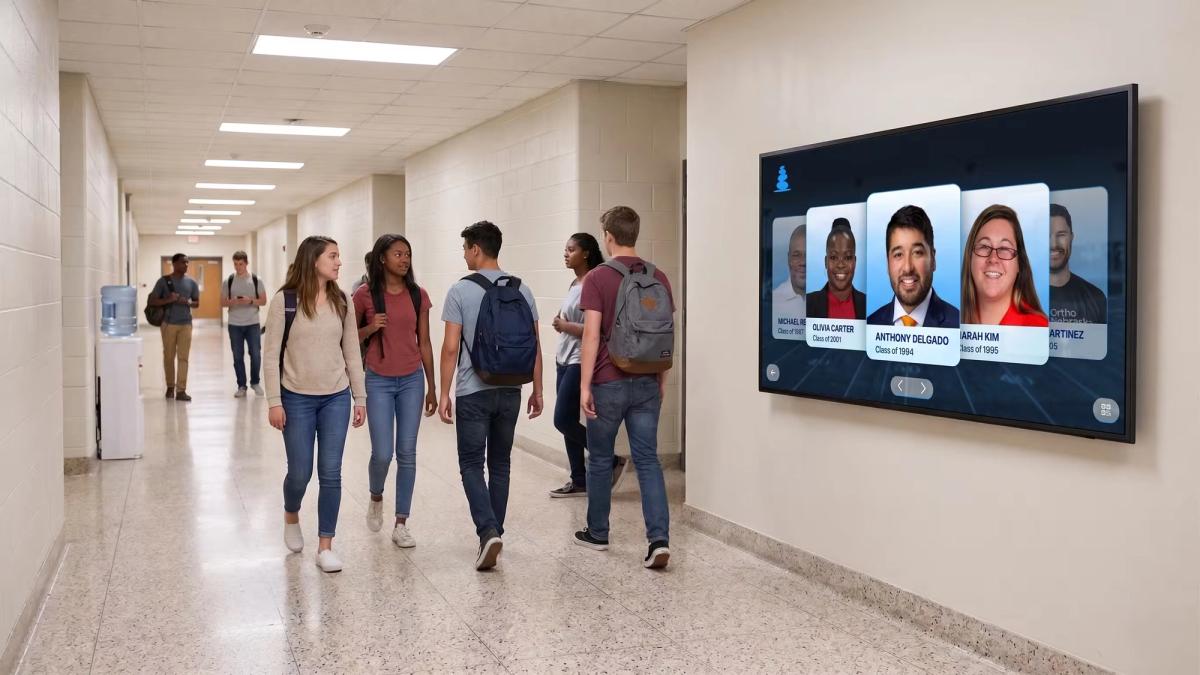
At Touchstone Digital Solutions, we work with private schools, colleges, and universities to bring that institutional history to life through wall-mounted interactive touchscreen displays. Hall of fame records, donor recognition walls, alumni achievements, academic milestones, championship histories: all of it, searchable, dynamic, and accessible. A legacy that never graduates.
The way this ties into digital record keeping is pretty straightforward, you can say it’s simple: your school’s story is still a record. And these days, for most institutions, it’s sitting in a display case that prospective families move past without giving it much of a second look, or it’s tucked away in a binder in an office, that has not been revised since 2015.
Schools have this real history that should not be dropped, and a future that should not be ignored, not even for a day.The schools that are winning on recruitment, donor engagement, and community connection are the ones treating their legacy as living, dynamic content; not static plaques.
The Future of Academic Records: Blockchain and AI in Student Data
The frontier is moving fast. Two technologies are reshaping what's possible in education records digitization.
Blockchain helps make academic credentials tamper proof , and it works in a decentralized way. After a transcript or diploma gets recorded, it does not really allow changes, and then any employer or university can check it in real time. MIT has already sent out blockchain verified digital diplomas, so it’s not in the experimental stage anymore.
AI is getting layered onto the existing record systems, so the place can automate data entry , catch compliance risks earlier before they escalate , and also help with predictive analytics about student outcomes. The schools that are putting solid digital infrastructure in place today are basically the ones that can stack these digital systems over what they already have without having to start from scratch.
The Bottom Line: Securing Your Digital Student Records Strategy
Digital record keeping in education; done right, is both a compliance shield and a competitive advantage. For private schools and universities especially, it's the foundation of how you protect your students, your institution, and your reputation.
And if you are going to digitize your school's history , don t stop at the administrative records. Bring the whole story into the digital age, like really everything, not only the files that sit quietly in folders.
That's exactly what Touchstone Digital Solutions helps schools do through effective digital transformation. Recognize anyone. Celebrate anything. Reach everyone with just one click through streamlined digital communication.
Explore what Touchstone can do for your school and see why our proud partners call it ROI beyond measure.