

From track meets to field trips to spring dances and donor galas, a private school generates more fees for events within a semester than many small companies do in a year. Every one of those events comes with its own quiet math problem, especially when considering the track day insurance and other associated costs. Who pays what, when it's due, and where the money actually goes once it lands.
If you've ever tried to reconcile a spreadsheet of registration fees against three different payment apps at once, you already know the headache. That's exactly where the phrase track event fees becomes literal in two directions at once, reflecting both the costs incurred and the value provided to each athlete. There's the cost of putting on the event, and there's the job of actually tracking it once families start paying. Get both right and it changes how your whole community sees the school.
What Do School Event Fees Actually Cover?
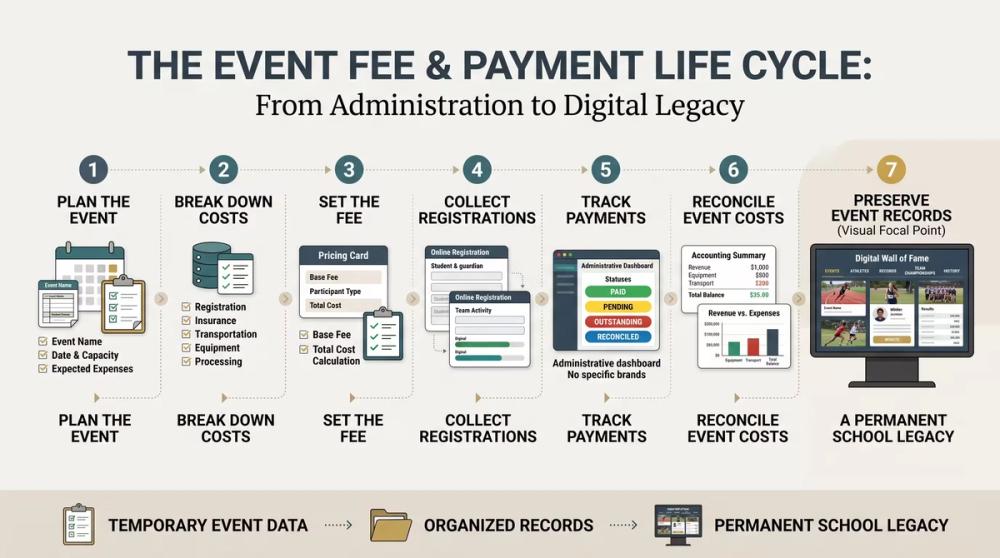
Whether it be a spring meet, a robotics contest, or a scholarship fundraiser, rarely is there ever just one price for an event. They stack. Registration, insurance, materials, transportation, officiating, and payment processing all get folded into that one line a parent sees on a form.
Understanding each piece is the first step toward tracking it properly, because a school can't manage what it hasn't broken down, including the various expenses related to each session. A "fifty dollar meet fee" might actually be covering timing equipment, a bus rental split five ways, and a processing charge nobody mentioned out loud.
How to Track Track and Field Event Fees
Athletics programs are a perfect example of how fast this gets complicated, particularly when factoring in the tire expenses for athletes. Parents searching for high school track meets near me or trying to figure out how long high school track meets run are usually also quietly wondering how much does it cost to compete this season, including the track day costs.
Add in middle school track meet events, indoor track events in the winter, and away meets that require transportation, and a single sport can generate a dozen different fee categories before the season even starts. Multiply that across every athletic program, club, and academic competition a school runs, and it's easy to see why fee tracking turns into a full time job nobody actually has time for, especially when considering the costs of a typical track event.
Why School Event Fee Structures Get Complicated
Athletics organizations in the United States deal with the same layering problem, especially through USA Track & Field (USATF) membership and meet-entry structures. USATF charges an annual membership fee, while athletes may also pay separate entry fees for individual events. For example, the 2026 USATF New England Indoor Track & Field Championships list an entry fee for a member's first event and extra for each additional event. At the USATF Dakotas All-Comers Meets, both members and non-members can compete, but the entry fee is $10 per event for USATF members compared with $13 for non-members.
This structure is not unique to large athletics organizations. It reflects the same approach schools use when they charge different amounts based on registration timing, membership status, or participation type. Once multiple fee categories are introduced, tracking becomes more complicated. Athletic departments and school administrators may need to account for memberships, event entries, deadlines, participant types, and additional fees when calculating the overall cost for each athlete.
Hidden Costs in School Event Fees and Payment Processing
The advertised fee is rarely the final fee. Payment platforms often take a percentage plus a flat charge per transaction, and ticketing fees can quietly inflate the real cost of running an event without anyone noticing until the invoice shows up.Similarly, late charges, deferment costs, and processing fees perform a similar function at a much lower level.
For those institutions wishing to avoid budget uncertainty, it would be wise to select the flat fee or cap fee systems from the outset, instead of finding out about the real cost once the season has already ended. If anyone is curious to know how much a season really costs once all the extras are included, the answer is likely to be more than what’s on the application form.
How Schools Can Track Event Fees and Manage Payments Efficiently
A few habits go a long way in helping coaches and administrators keep track of all expenses related to their programs.
- Centralize every event's fee schedule in one place instead of scattering it across email threads and paper forms that only exist in someone's desk drawer.
- Quote the full price up front, the way race organizers now advertise entries as fully inclusive of tax and processing, so families never get a surprise line item after the fact.
- Move collection online wherever possible, since a digital form reconciles itself instead of leaving it to whoever is holding the cash box after a Friday night meet.
- And keep program specific costs, like uniforms, travel, or equipment rental, clearly separated from the base entry fee, so families can see exactly what they're paying for and why, including any additional expenses for each session.
How Digital Record Keeping Helps Schools Track Event Information
This is where a digital legacy platform earns its keep by efficiently managing all aspects of athlete participation and associated costs. Touchstone Digital Solutions doesn't process payments, but it solves the half of this problem most schools quietly ignore, which is showing families and donors what all that fee collecting actually paid for. Season schedules, results, and records live on one interactive touchscreen instead of buried in a folder nobody opens.
Donor walls and annual giving reports show alumni and families exactly what their contributions funded, turning a fee or a gift into a story instead of just a receipt. For a private school trying to justify program costs to a board, a parent, or a prospective donor, that kind of transparency does more work than another spreadsheet ever could. It's a legacy that never graduates, and it's one of the simplest ways to prove that every dollar tracked actually went somewhere real.
Best Practices for Tracking School Event Fees and Payments
Tracking event fees will never be glamorous work, but it doesn't have to be chaotic either, especially if coaches implement a clear system for managing expenses. Break the fee down into its real parts, watch for the hidden add ons, centralize how it's collected, and give your community a clear way to see what those fees actually built. That last part is where most schools leave value on the table, and it's exactly the gap Touchstone was built to close for every athlete involved in their programs.