
SHORT ANSWER
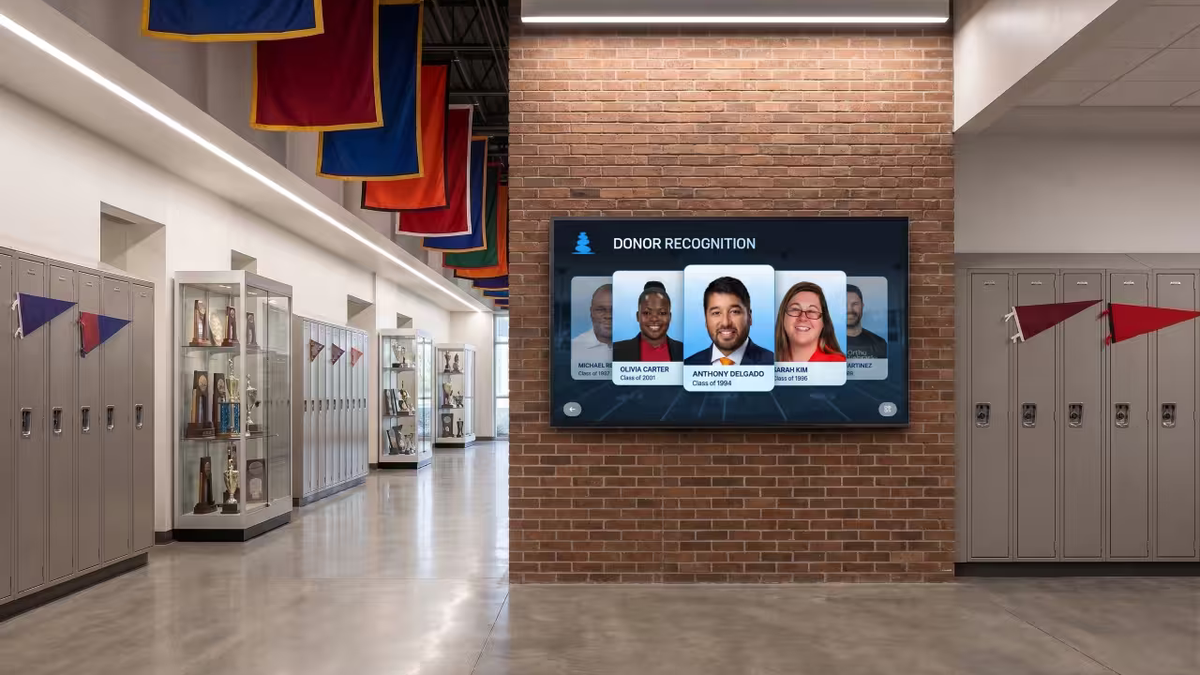
A traditional donor wall costs less upfront and offers the prestige of an engraved name, but it fills up, costs money every time you add a donor, and takes weeks to update. A touchscreen donor wall costs more as a one time purchase, yet it holds unlimited donors, updates instantly and in house with no engraving fees, and adds photos, video, and stories that a plaque cannot. For most growing institutions, the touchscreen wall is the better long term value; a traditional wall still fits organizations with a fixed donor list, a tight upfront budget, or a community that prizes engraved permanence.
WHY THIS DECISION MATTERS
Both a touchscreen and a traditional donor wall serve the same purpose: to recognize established donors and inspire new ones. The traditional option offers lower short term costs and a sense of prestige but higher long term update costs and spatial limits. The touchscreen alternative is more expensive as a one time purchase but more budget friendly over time, offering instant updates, unlimited donor capacity, and physical space conservation.
To choose well, it helps to compare the two across four categories: costs, capacity, efficiency, and effectiveness.
HOW MUCH DOES EACH OPTION COST?
Touchscreen: A complete interactive donor wall typically runs $10,000 to $30,000 for an entry level system and $20,000 to $65,000 for a larger, content rich installation. That figure covers the commercial grade touchscreen, software, and setup. Ongoing costs are modest, around $1,500 to $8,000 per year for software, hosting, and support, because new donors are added in house with no per name fabrication fee.
Traditional: A traditional wall is cheaper to start, with engraved plaques running roughly $50 to $400 each plus $50 to $150 in installation labor per donor, and a custom backboard or wall system adding another $3,000 to $15,000. The catch is the long tail: every new donor adds $150 to $500 in fabrication, so an organization adding 20 to 50 names a year can spend $3,000 to $25,000 annually and indefinitely, and a single misspelling means paying to re-engrave.
HOW MANY DONORS CAN EACH WALL HOLD?
Touchscreen: A single touchscreen holds effectively unlimited donor profiles: thousands of names, plus photos, videos, and stories, all searchable by name, class year, or donation tier. Because the display never fills up, you simply add records as your donor base grows, so one wall scales across decades of future campaigns.
Traditional: A physical wall is bounded by the square footage you install, and once the panels are full you either stop recognizing new donors or pay to expand. Each donor is usually limited to a single engraved line, leaving no room for the photos, gift details, or stories that make recognition feel personal.
HOW QUICKLY CAN YOU UPDATE EACH WALL?
Touchscreen: Updates are made in house through a content management system and appear instantly, so a new gift can be recognized the same day it arrives. There is no ordering, engraving, shipping, or re-mounting, which eliminates the multi week turnaround and rush fees that physical updates require. Edits can be made in seconds and pushed live.
Traditional: Adding or correcting a name means commissioning a new plaque, waiting on engraving and shipping, and scheduling installation, a cycle that commonly takes several weeks if not months. Because each change is effectively a small fabrication project, even a simple typo fix carries real cost and delay.
WHICH WALL IS MORE EFFECTIVE AT INSPIRING DONORS?
Touchscreen: Interactive displays invite people to explore, and the engagement gap is striking. Institutions commonly report visitors interacting for several minutes with a touchscreen versus a quick glance at a plaque, with overall engagement reported many times higher. [Insert source or soften this claim before publishing.] That richer multimedia experience is what turns simple recognition into a tool that inspires recruits, alumni, and future donors.
Traditional: For some supporters, especially older major givers, the permanence of a name carved in brass carries real emotional weight and a sense of prestige that a screen cannot fully replicate. A static wall also has zero technology dependencies: once installed, it simply works, with no software, power, or maintenance to manage.
Side-by-Side Comparison
| Touchscreen | Traditional | |
| Costs | Higher upfront ($10K–$65K all-in); low ongoing ($1.5K–$8K/yr) with no per-name fees | Low upfront ($50–$400/plaque + $50–$150 install); high long-term ($150–$500 per new donor; $3K–$25K/yr as you grow) |
| Capacity | Effectively unlimited; thousands of searchable profiles with photos, video, and stories | Limited by physical wall space; ~1 line per donor; fills up and needs costly expansion |
| Efficiency | Instant in-house updates via CMS; same-day recognition; typos fixed in seconds | Weeks-long cycle to engrave, ship, and install; corrections require re-fabrication |
| Effectiveness | 4–8 min average interaction (~8–12× higher engagement); dynamic storytelling | Permanence and prestige; zero tech dependency; emotionally resonant for some donors |
THE BOTTOM LINE
A donor wall exists to maintain positive relationships with previous donors and inspire new ones through a sense of pride. For an organization choosing between traditional and touchscreen displays, a digital option that connects donors across the world with live updates aligns strongly with that networking goal. The right choice still depends on your priorities: a traditional wall remains a fitting option for organizations with a fixed donor list, a tighter upfront budget, or a community that values the prestige of an engraved name. For institutions that expect to keep growing their donor base, the touchscreen wall is the better long term investment.
FREQUENTLY ASKED QUESTIONS
How much does a touchscreen donor wall cost?
A complete touchscreen donor wall typically costs $10,000 to $30,000 for an entry level system and $20,000 to $65,000 for a larger, content-rich installation. That one-time figure covers the commercial grade display, software, and setup. Ongoing costs run roughly $1,500 to $8,000 per year for software, hosting, and support, with no per name engraving fees, because new donors are added in house.
Can donors and alumni view the donor wall from anywhere?
Yes. Because the content lives in a cloud based content management system, the same donor profiles, photos, and stories shown on the in building touchscreen can also be shared through a secure web link. Alumni, donors, and recruits can then explore your recognition wall from a phone or laptop anywhere in the world, something a fixed engraved wall cannot offer.
What happens to our donor content if the screen ever needs to be replaced?
Your content is stored in the cloud, not on the physical screen, so it is never lost. If a display needs servicing or replacement, the new screen syncs to your existing account and every donor profile, photo, and video reappears exactly as before. This is a key advantage over an engraved wall, where the content and the hardware are permanently the same object.
How long does a touchscreen donor wall last?
Commercial grade displays are built for continuous public use, with panel lifespans frequently exceeding 60,000 hours and typical service lives of 7 to 10 years before replacement.
Can I use both a traditional and a touchscreen wall?
Yes. Many institutions pair a classic engraved wall for founding or marquee donors with a touchscreen that holds the full, ever growing donor list and tells the deeper stories a plaque cannot.
What size touchscreen do I need?
It depends on viewing distance: roughly 43 to 55 inches for a 4 to 6 foot approach, 55 to 65 inches for 6 to 10 feet, and 75 to 86 inches for larger lobbies and atriums. At Touchstone, our general guidance is that bigger is better.
Do touchscreen walls require an ongoing subscription?
Most include annual software, hosting, and support, commonly $1,500 to $8,000 per year, which covers content management and keeps the system updated and secure.
What features does a touchscreen donor wall have?
A touchscreen donor wall can include searchable donor profiles, photo and video galleries, giving tier and campaign organization, 3D scans, interactive maps, timelines, naming opportunities, and yearbook or archival integrations. Content is organized so visitors can explore by name, class year, sport, or donation level, turning a static list into a living story.
ABOUT TOUCHSTONE DIGITAL SOLUTIONS
Touchstone Digital Solutions is a family owned and operated company that creates memorable, custom Hall of Fame, Donor Wall, Team Wall, and other touchscreen experiences for schools, colleges, and universities trusted by programs across the ACC, Big Ten, Ivy League, and beyond. Every institution has a remarkable story, but trophies, static displays, and PDFs can only tell so much. We help bring history to life through interactive experiences that engage recruits, donors, alumni, and fans without breaking your budget. Ready to celebrate your legacy? Contact Touchstone to schedule a demo today.