A school reached out to me not long ago about a specific yearbook from 1911 that was basically one sneeze away from becoming confetti. That book had survived a world war, a handful of building moves, and who knows how many basement floods, and now it was on someone's desk waiting for a decision. It got me thinking about how differently you have to treat a physical yearbook like that compared to last year's edition of digital copies.
If you are holding a yearbook that predates your school's oldest living alumni, you already know the stakes are higher than a normal scanning job. This is not "run it through the office copier" territory; it's about ensuring the integrity of your high school yearbook. This is the kind of physical yearbook where one wrong move at the spine turns a century of history into a pile of loose yearbook pages. Here is what actually matters when you go looking for yearbook scans of something this old, and how to find a provider who will not treat your high school yearbook archive like a stack of copy paper.
What Are Yearbook Scans? Understanding Archival Scanning for Old Yearbooks
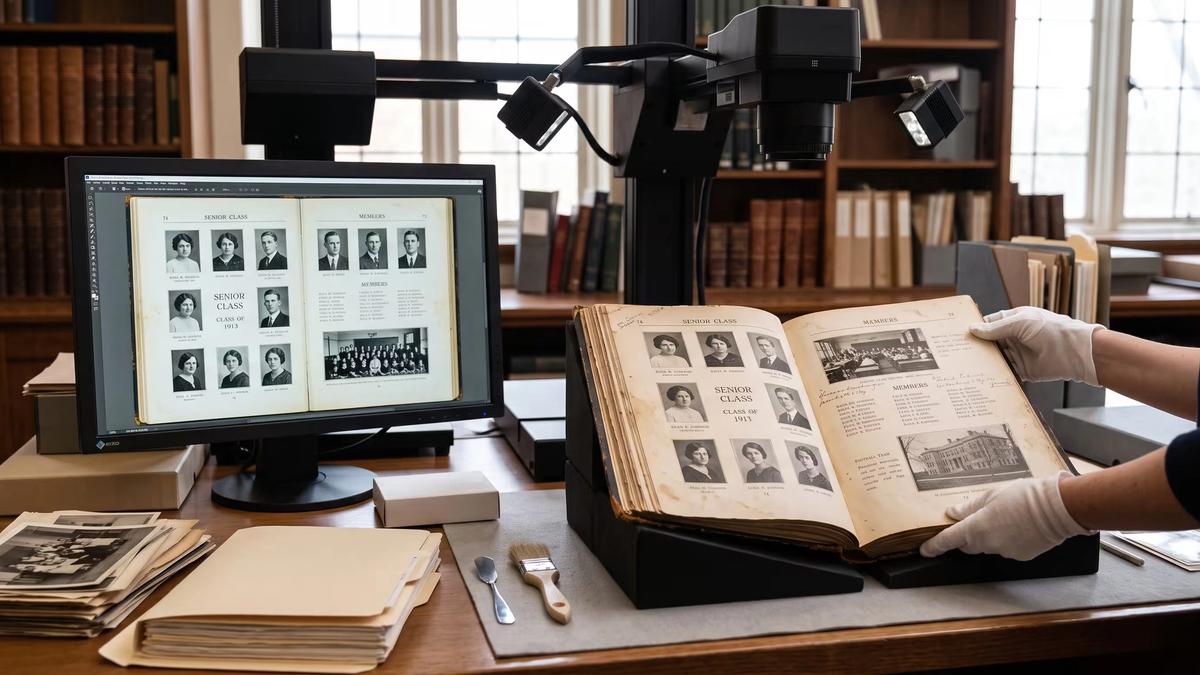
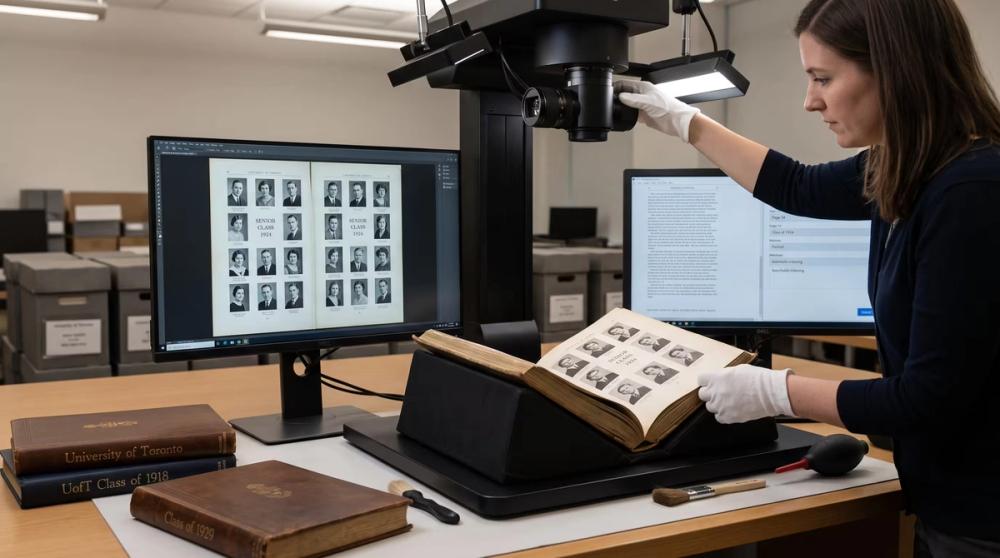
Modern yearbook scanning covers everything from last year's edition to digital yearbooks held together mostly by hope. For a book from the early 1900s, "yearbook scans" should mean non-destructive capture, meaning the physical yearbook never gets forced flat or cracked open past what the binding can safely handle. Reputable providers use overhead camera scanners or V cradle setups built specifically for fragile bound volumes, and they will tell you up front which method they plan to use on your book before it ever leaves your building. If a provider cannot answer that question clearly, that is your answer right there regarding their ability to handle your yearbook digitization needs.
Are Old Yearbooks Worth Anything? Understanding Their Historical Value
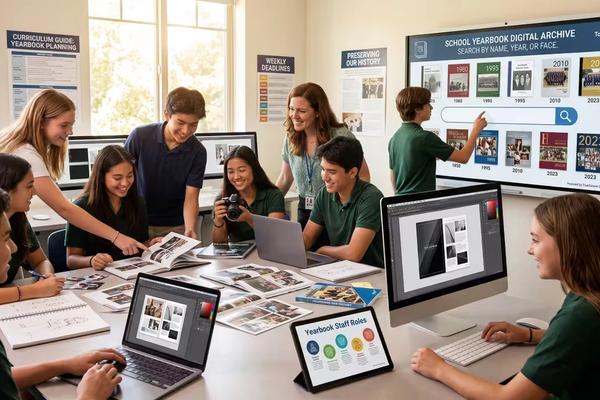
Short answer: typically something that isn't really expected, often more than one person thinks about their digital archive. A hundred-year-old yearbook is unlikely to be valuable in the resale market unless it's someone famous or has a rare signature.Its real value is institutional. It is the only surviving record of who your high school was before anyone alive today ever set foot on campus, making it invaluable for preserving your school's history. That's more valuable to your alumni office and admissions team than any auction house price tag, and that's why institutions are scanning these documents and putting them on a searchable database instead of in a closet where they'll be overlooked.
How to Determine the Value and Condition of an Old Yearbook
A few quick checks before you send your school yearbook off. Look for a printed date and publisher name, since older books without either can be harder to date and catalog properly. Check the binding type; cloth bound high school yearbooks from this era tend to survive scanning better than the cheaper glued editions. And take stock of condition per decade if you have multiple volumes, because your 1910s books likely need a different handling approach than your 1970s books. A good provider will ask you these same questions about your yearbook archive before quoting a price.
What to Look for in a Yearbook Scanning Service
Not every scanning service near me is going to turn up someone equipped for archival work. Here is what separates a real yearbook scanning service from a general purpose print shop. Ask what resolution they scan at since archival masters of your high school yearbook archive should run 400 to 600 DPI while access copies around 300 DPI is fine for everyday browsing of yearbooks online. Ask whether the process is non destructive because a cracked binding cannot be undone once it happens. Ask if they offer OCR, which is what actually makes names and clubs searchable later instead of just sitting there as flat images. Ask about their quality control process too, and push for specifics on whether they check pages during scanning or only at the very end of the digitize yearbooks process. And ask how they handle courier pickup, since a century-old school yearbook should never travel in a regular mailer.
Pricing for standard sized yearbooks generally runs in the flat rate range per book, with older or oversized volumes sometimes priced per page instead. Turnaround for a full archive project typically runs two to four weeks for the scanning itself, plus more time if you are adding OCR and metadata on top for your digital copies.
How to Digitize Old Yearbooks Legally: Copyright and FERPA Considerations
This trips people up more than it should when trying to digitize yearbooks online. Copyright status depends heavily on the publication date of the school yearbook. In the USA, the yearbooks published before 1928 are public property, while those published between 1928 and 1963 require an additional check for copyright renewals, and the books published in 1978 and later are protected for 95 years from their publication date. To avoid copyright infringement, if your book is going to be published in public websites rather than the school’s internal site for archiving purposes, you may want to consider including an opt-out procedure for students who do not wish their photograph to be published, and it will fulfill their privacy needs like FERPA.
Where to Find Digitized College Yearbooks and Historical Archives
If part of your goal is simply locating a copy of a specific yearbook that no longer exists in your own archive, a couple of resources are worth bookmarking. Yearbook.org's search tool lets alumni look up names across previously digitized collections, and if you are starting from zero with an incomplete archive, this general guide to locating old yearbooks walks through where copies tend to surface, including class reunions and estate sales.
How to Digitize Century-Old Yearbooks Without Damaging Them
A century old yearbook cannot take much pressure at all, and the right provider treats it that way from pickup to delivery, with condition checks, non destructive handling, and metadata that actually makes the archive useful once it is online. Touchstone's yearbook scanning process was built around exactly this kind of fragile, historically loaded material, walking through the full workflow from intake to searchable digital delivery in our step by step digitization guide.
If your school has a box of yearbooks nobody has opened since the Truman administration, do not let another year go by hoping the binding holds. Reach out to Touchstone Digital Solutions and get a free sample scan on your oldest yearbook collection before you commit to anything. Your yearbook collection deserves better odds than a coin flip against time in the quest for preserving yearbook content.