Picture this. Your exams run smoothly, scores post in minutes, and everyone's happy. Then a parent asks where their child's results are actually stored, and the room goes quiet, raising concerns about data security in the digital world.
The aspect of digital assessment security is not exciting. It is the first and mostly bad memory that has to do with the experience. This guide explains how educational institutions safeguard students' data while using various digital assessment tools.
What Is Digital Assessment Security in Schools?
Digital assessment security involves the combination of techniques, policies, and practices used to safeguard exam materials, students' personal information, and results. Specifically, it has three purposes: preventing leakage of questions, ensuring that only authorized people take the examination, and keeping personal information out of reach of unauthorized persons.
This post focuses on that third job, because it's where schools carry the most legal responsibility.
What Student Data Do Digital Assessment Platforms Collect?
More than scores; we have metrics that reflect true academic performance. An online assessment platform can offer you the capacity to save all of your names, ID numbers, accommodation records, webcam captures, work samples, and log-in info. All of those qualify as educational records according to the FERPA regulations as long as your institution keeps those on file for verification of qualifications.
Our first step is to take inventory. What do we have in terms of assessment design? Where is it kept? Who has the authority to access it? How long do we hold on to it? Answering these questions holds the key to understanding the governance of assessment data and identifying existing loopholes in maintaining academic integrity.
5 Best Practices for Digital Assessment Data Security
Five moves do most of the heavy lifting.
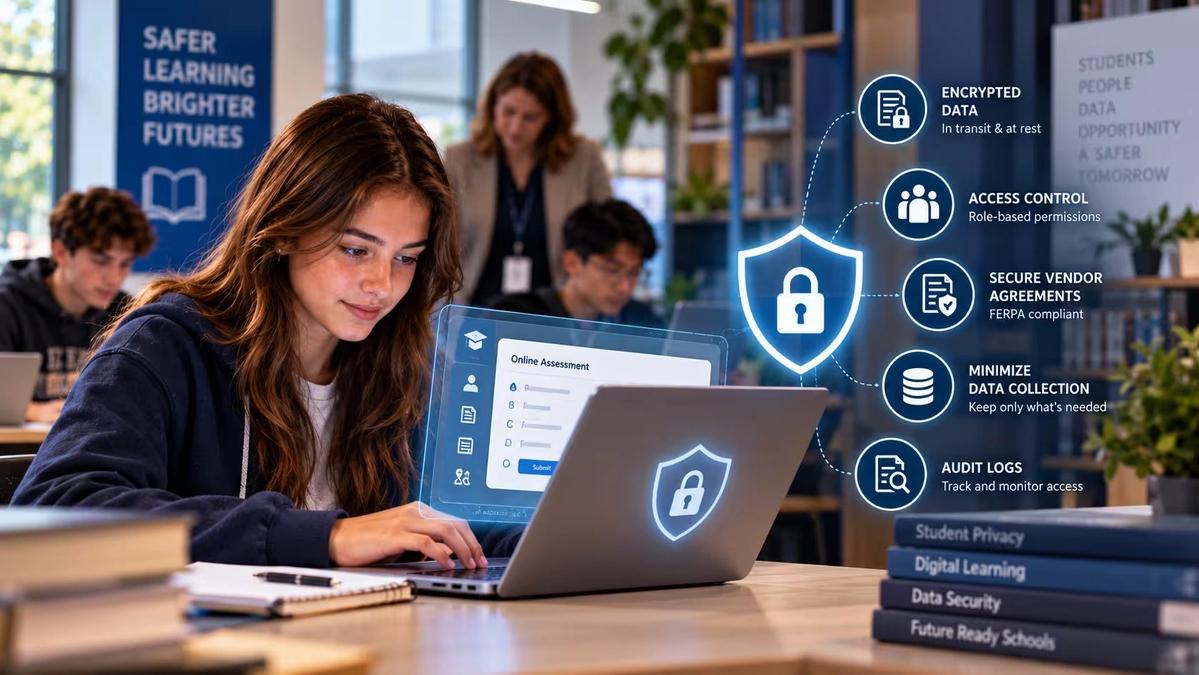
1. Encrypt Student Data in Transit and at Rest
The information needs to be secured both while it is being transmitted as well as when it is stored on the server. All suppliers must confirm this in writing. If they refuse to provide an answer to this question, that already gives you all the information you need.
2. Restrict Access to Assessment Data
Access should match the job, particularly in roles related to assessment design and academic integrity. A teacher sees their own classes, not the whole campus. Add multifactor authentication for staff and admins, because passwords alone are so 2012.
3. Strengthen Vendor Contracts and Data Protection Agreements
Under FERPA, a school may disclose records to contractors under the school official exception so long as the contractor is acting under the direct control of the school. Although it is not necessarily required that a written agreement exist, it's generally accepted that this is best practice. So get one. A solid data processing agreement stipulates the vendor's hand-in-glove relationship with the district-that is, it severely restricts how student data may be used, forbids resale, and mandates the deletion of all student data once the contract concludes.
4. Minimize Student Data Collection and Retention
Collect only the data the exam requires. Retain records of test sessions with appropriate time limits and delete them automatically to prevent misconduct. The less information you retain, the less chance there is of it being lost or stolen
5. Use Audit Logs to Monitor Assessment Data Access
Audit trails can record who accessed the data and when. In the event of an incident, they transform speculation into an evidential audit trail.
Digital Assessment Security Checklist: Questions to Ask Vendors
Here's a data security questionnaire template you can borrow. Send it to every vendor before the demo ends:
- Where is our data stored, and in which country?
- Is data encrypted in transit and at rest?
- Who on your team can see student records?
- Which subprocessors touch our data?
- How quickly will you notify us of a breach affecting the verification of academic credentials?
- What happens to our data when we leave?
- Can we export everything in a usable format?
- How do you support accessibility standards?
Vague answers are red flags. Specific answers backed by documents are green ones.
Security Risks of Free Online Assessment Tools for Teachers
Teachers love free online assessment tools, and who can blame them? It's all just quick, easy, and friendly, but we must prioritize academic integrity. But that's exactly the problem. With no one reading the fine print, student data can quickly become the price of misconduct in the digital world. Every new electronic assessment tool for teachers should pass through the same vendor checklist.
Online Exam Proctoring and Student Data Privacy Risks
Plenty of schools add proctoring and consider digital exam security handled. Here's the catch regarding maintaining academic integrity during assessments. An undercover study that ran for more than a year found that proctors missed over 90% of cheating attempts. Among remote test takers who used a phone, 96% photographed exam questions without being caught. And in a controlled experiment, an AI proctoring tool flagged none of the six students who were asked to cheat, highlighting the importance of maintaining academic integrity.
Proctoring introduces additional sensitive data such as facial features and voices and, possibly, bedroom walls. Every resulting video requires additional security measures in terms of restricted storage and access. The company should limit the retention period and the personnel allowed to review the recordings as a part of the proctoring service to ensure compliance with academic integrity standards.
Student Data Privacy Laws and Compliance Requirements for Schools
FERPA isn't the whole story. States have passed more than 150 new student data privacy laws, and some add rules for vendors. Check yours, then write those requirements into your contracts.
How to Conduct a Student Data Security Risk Assessment
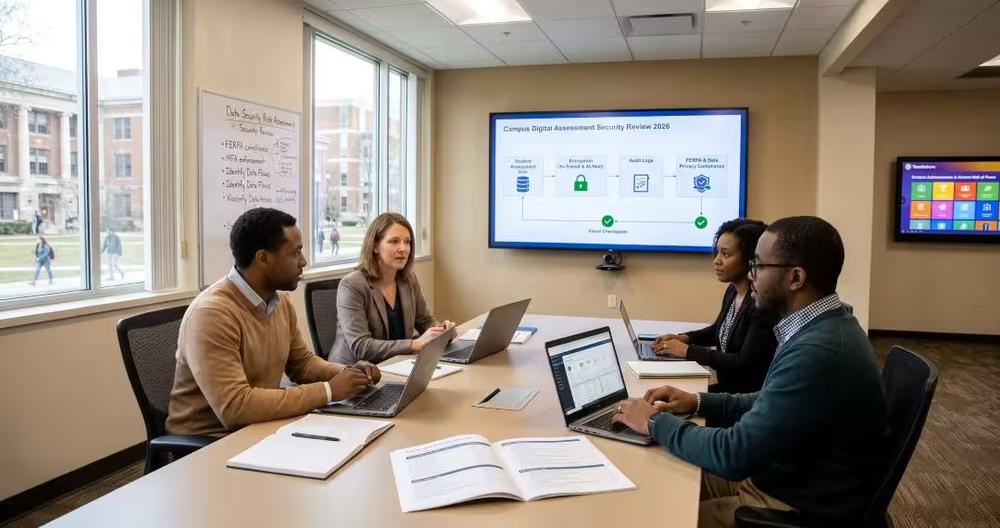
So, what is a security assessment? It's a structured check of what could go wrong, how likely it is, and how bad it would be. Run one every year and whenever you add a platform. A simple version looks like this: a qualification verification process that ensures academic integrity.
Inventory your data and every platform that touches it.
Rate each risk by likelihood and impact.
Test who has access, and remove what's stale.
Review vendors against your questionnaire.
Assess data maturity: what's documented, and what's just habit.
Write down the fixes, assign owners, and set dates.
Digital risk assessment tools and a risk assessment cyber security template can speed things up. The goal is a data security posture you can explain to your board in five minutes, ensuring academic integrity in the digital world.
Preserve School History With Interactive Digital Recognition Displays
Securing assessments is one half of going digital. The other half is deciding what to do with the history sitting behind glass in your hallways. Schools have rich histories that should not be forgotten, and that's the problem Touchstone Digital Solutions solves for our proud partners.
We turn static halls of fame, plaques, and records into memorable interactive experiences that you can use to celebrate and recognize anyone, anywhere, for any achievement with a single click. Built on a cloud platform with an intuitive content management system, it's simple to update honor rolls, alumni profiles, and donor information without any technical expertise. No more glitchy software or outdated displays. No more limitations on display space. Get your school's story out to visitors and parents on any device.
Ready to give your legacy a digital upgrade? Contact Touchstone Digital Solutions and let's talk about your campus. A legacy that never graduates deserves a display that keeps up.