Donor recognition levels are giving tiers, each with a name, a gift range and a defined way of thanking the people inside it. Good ones do three things. They tell donors what their gift means, they give donors a reason to move up one step, and they give your staff a fair rule to apply every time. This guide shows you how to set the thresholds, name the tiers, choose the benefits and write the policy that keeps it all consistent for years.
Touchstone Digital Solutionscalendly.comMake Donor Recognition Grow With YouTouchstone creates custom digital donor recognition walls that bring school stories together and can grow as new donors are added.Schedule a guided demo
TL;DR
- Use four to six tiers with round-number thresholds and gaps wide enough that moving up feels like an achievement.
- Name tiers after your school, mascot, colors or mission, and keep naming rights for your largest gifts only.
- Match recognition to the gift: personal thanks for every donor, public recognition for mid-level donors, naming opportunities at the top.
- Write the policy down (what counts, how long recognition lasts, who can revoke it) before the first plaque or screen goes up.
- Choose a display that can grow with your tiers, so adding a donor never means reordering a wall.
Table of Contents
- What donor recognition levels are and why they matter
- How to set your gift thresholds
- Real examples from universities
- Naming your tiers
- What each level should include
- Keep recognition meaningful, not transactional
- Write the policy before you build the display
- Showing your levels on a donor wall
- Perspective: why flexible tiers matter
- Bringing your levels to life with Touchstone
- A simple way to get started
- FAQ
- Sources
What donor recognition levels are and why they matter
A recognition level is a promise. A donor gives at a certain range, and your organization responds in a consistent, visible way. The Association of Donor Relations Professionals (ADRP) says in its 2017 best practices for donor recognition that recognition should be offered in proportion to the donor’s generosity. It also says recognition should name the donor accurately and acknowledge the specific nature of the giving.
That last point matters for schools. A parent who gives $250 to the band and an alumnus who gives $250,000 to a new field house are both donors. They should not receive the same treatment, and neither should feel overlooked. Levels are how you do both.
Well-built tiers also help you in three practical ways:
- Staff know exactly what to send, say and display for each gift.
- Donors can see the next step up without being pushed.
- Boards and advancement committees can defend decisions, because the rules were set in advance.
How to set your gift thresholds
Start with your own data, not a template. Pull a list of every donor from the last fiscal year or two, sorted by total giving. Look for natural clusters: a large group giving under $100, a smaller group around $500 to $1,000, a handful above $10,000. Your thresholds should sit at the edges of those clusters.
A few rules of thumb we share with the schools we work with:
- Four to six tiers is enough for most K-12 schools and athletic programs. Universities with large major-gift programs often need more.
- Use round numbers ($100, $500, $1,000, $5,000). Odd figures look like a price list.
- Leave real gaps. If Silver starts at $500 and Gold at $600, nobody feels they have achieved anything by moving up.
- Set the top tier a stretch above your current largest gift, so there is somewhere to grow.
- Decide whether tiers count a single year, a lifetime total or both. Say so in plain language.
It can help to see how other organizations publish their thresholds. A look at common giving thresholds shows how a mission-driven organization presents giving in simple, readable steps.
Annual, cumulative or lifetime
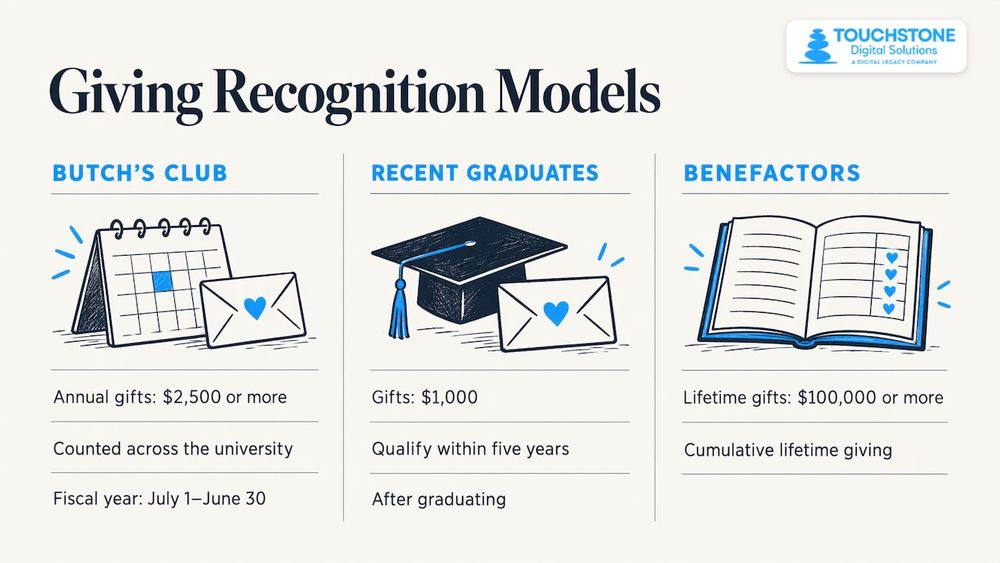
This choice shapes everything else. Washington State University’s Foundation, for example, recognizes Butch’s Club members at cumulative annual gifts of $2,500 or more, counted across the university in a single fiscal year from July 1 to June 30. Recent graduates qualify at $1,000 within five years of graduating. That is a thoughtful way to welcome young alumni without lowering the bar for everyone else.
The same foundation recognizes lifetime giving separately. Its Benefactors group begins at $100,000 in cumulative lifetime gifts. Annual and lifetime tiers can coexist, as long as each has its own name and its own rule.
Real examples from universities
Public university policies are a good reality check, because they are written down and tested. Here is how three of them structure their levels.
| Institution | Structure | Example thresholds |
| Montclair State University | Nine major-gift levels per fiscal year | Level 1 at $25 million or more; Level 5 at $1 million to $2.5 million; Level 8 at $25,000 to $99,000; Level 9 under $25,000 (group plaque) |
| WSU Foundation | Annual club plus lifetime groups | Butch’s Club at $2,500 a year; Silver Benefactor at $250,000 to $499,999; Crimson Benefactor at $500,000 to $999,999; Laureates at $1 million or more |
| University of Wisconsin-Eau Claire Foundation | Eight cumulative giving levels | Blue & Gold Society at $10,000 to $24,999 up to Legacy Society at $10 million and above |
Three patterns stand out:
- Numbers rise steeply at the top. Each step often doubles or more.
- Names do real work. “Crimson Benefactor” and “Blue & Gold Society” could only belong to those schools.
- Entry points differ by donor type. UW-Eau Claire begins its Circle of Excellence at $10,000 for individual gifts and $25,000 for corporate and foundation gifts.
Your school does not need nine levels. A high school booster club might run Bronze at $100, Silver at $500, Gold at $1,000, Platinum at $5,000 and a Founders level at $10,000, and that is plenty.
Naming your tiers
Generic metal names (Bronze, Silver, Gold) are easy and familiar. They work, but they say nothing about you. Names drawn from your school feel like membership rather than a price list. Think about:
- Your mascot (Eagle Club, Wildcat Circle)
- School colors (Maroon Society, Blue & Gold Society)
- Founding dates or founders’ names
- Campus landmarks, mottos or traditions
- Athletic terms (Starter, Captain, Letterman, Hall of Fame Circle)
We cover this in more depth in our guide on how to name your donor recognition levels. The short version: pick names your students would say out loud without cringing, and make sure the order is obvious. Nobody should have to wonder whether “Captain” outranks “Starter.”
What each level should include
Think of recognition as three layers, and give each tier the right mix.
Personal recognition
Every donor, at every level, deserves a prompt, personal thank-you: a letter, a call from a coach or principal, a note from a student. This costs almost nothing and it is the layer donors remember. Higher tiers can add a meeting with leadership, a campus tour or a private event.
Public recognition
Honor rolls, annual reports, donor walls, plaques and certificates all sit here. This layer shows the community who supports the school, and it gives other families a reason to join in. Public recognition usually begins at a modest threshold and grows more prominent as gifts increase.
Naming opportunities
Naming a room, field, scholarship or building is the most valuable thing you can offer, so treat it that way. Reserve it for your largest gifts, and set the minimum in writing. The University of Colorado Anschutz’s public recognition standards, for example, set a $100,000 minimum for any formal naming opportunity and prohibit naming individual items such as benches and trees.
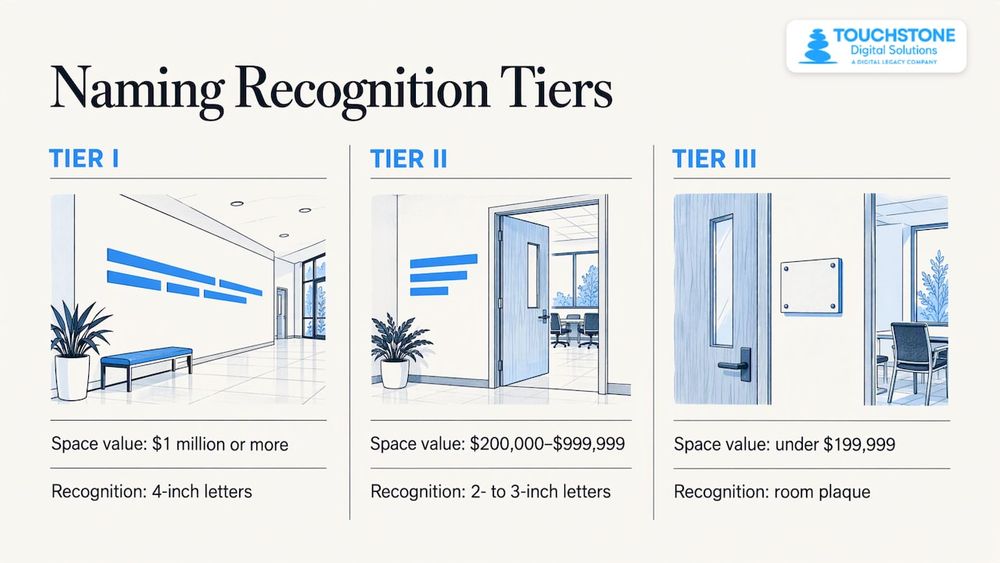
The University at Buffalo ties the size of the recognition to the value of the space. Its guidelines give Tier I spaces valued at $1 million or more 4-inch letters, Tier II spaces from $200,000 to $999,999 2-inch to 3-inch letters, and Tier III spaces under $199,999 a room plaque. A school can borrow the logic at any scale: the bigger the gift, the more prominent the recognition.
Giving societies versus membership clubs
The ADRP notes that giving societies often steward cumulative or planned giving and traditionally carry no annual fee, while membership clubs charge an annual fee with benefits that grow by tier. Most schools want a giving society: donors qualify by giving, and nobody pays to belong.
Keep recognition meaningful, not transactional
Recognition should feel like gratitude, not a receipt. A few ways to keep it that way:
- Lead with the impact. Tell donors what their gift made possible: new uniforms, a renovated gym, a scholarship for a named student.
- Make benefits experiences rather than merchandise. A behind-the-scenes look at a rehearsal or a seat at the signing-day celebration says more than a mug.
- Thank donors more than once and at different times of the year, not only at the ask.
- Keep the lowest tier warm. A first-time donor of $25 is a future major donor, and how you treat them now is part of that story.
- Let donors choose how they appear. Some want their name on the wall, others prefer to stay anonymous.
We also share ideas for digital donor engagement that work between campaigns, when donors are deciding whether to give again.
Write the policy before you build the display
The single best protection for your program is a written policy. The ADRP stresses that written policies and procedures should detail how and why you recognize donors, and be communicated across the organization so recognition stays equitable. Here is what a good one covers.
What counts toward a level
Snow College Foundation’s policy shows one clear approach: donors whose accumulated contributions equal one year of tuition and fees, rounded up to the next $100, may be recognized on its Donor Wall of Honor, with amounts recalculated each July 1. A threshold tied to something the community understands, like a year of tuition, is easy to explain.
Also decide how you treat pledges and planned gifts. In a 2023 ADRP regional presentation, the guidance was that deferred gifts are only recognized when documented and irrevocable.
How long recognition lasts
Nothing lasts forever, and donors deserve to know that up front. The University of Washington’s Regent Policy No. 50 gives naming actions not supported by a permanent endowment an initial duration of seventy-five years, or the life of the building or space, whichever is shorter. The 2023 ADRP presentation likewise says recognition lasts until the space is relocated or substantially changed. For a deeper look, read our piece on how long donor recognition should stay up.
When recognition can be changed or removed
Spell out the conditions. The University of Minnesota’s Board of Regents policy reserves the right to rename or revoke a naming for specified mission, integrity, reputational-risk or gift-fulfillment reasons. Having the language in place before a difficult situation arises protects both the school and its donors.
A starting checklist
- List your tiers, thresholds and names.
- State whether each tier counts annual, cumulative or lifetime giving.
- Define what counts (cash, pledges, planned gifts, in-kind gifts).
- Set minimums for naming opportunities.
- Set a duration and a review date for each type of recognition.
- Name who approves exceptions.
- Describe how and when displays are updated.
Showing your levels on a donor wall
Tiers only work if donors can see them. A traditional plaque wall makes every new donor an expensive project: a new engraving, a new layout, sometimes a whole new panel. When a tier fills up, the design can run out of room. That is why many schools now choose a touchscreen display, where each tier is a section of the same system and a new donor is added in minutes.
A digital wall also lets you do things a brass plate cannot:
- Give every tier its own look and name, so the structure is obvious at a glance.
- Add a photo, a message or a story to higher-level donors without redesigning anything.
- Show the same recognition online, so alumni who live far from campus can find their names.
- Update after every gift or at the end of each fiscal year.
If you want to see how others have laid out their tiers, our donor wall examples show nine designs and what makes each one work, and the donor wall articles section covers more.
Perspective: why flexible tiers matter
We have built recognition displays for more than 350 schools and organizations, and the same thing happens in almost every project. A committee spends months debating tier names and thresholds, then discovers the display cannot easily change when the numbers do.
Our advice is to treat your levels as living. Your campaign will grow, your thresholds may shift after a few years, and a donor who gave at Silver in 2026 may give at Platinum in 2030. A display built around your school’s colors, logo and story should absorb all of that without a redesign.
That is why we design every donor wall around the school, not around a template. Tier names, imagery and layout come from your story, and our team trains your staff to manage the content. Donors who see their gift recognized in a way that feels like your school are donors who give again.
Gardner Gendron
Bringing your levels to life with Touchstone
We are a family-run company in Bedford, NH, and we build interactive recognition displays for schools, universities, athletic departments and community organizations. Our Digital Donor Walls are custom-designed around your colors, logo and tiers. We handle the full project: commercial touchscreen hardware, content setup and data migration, staff training and unlimited 24/7 support.
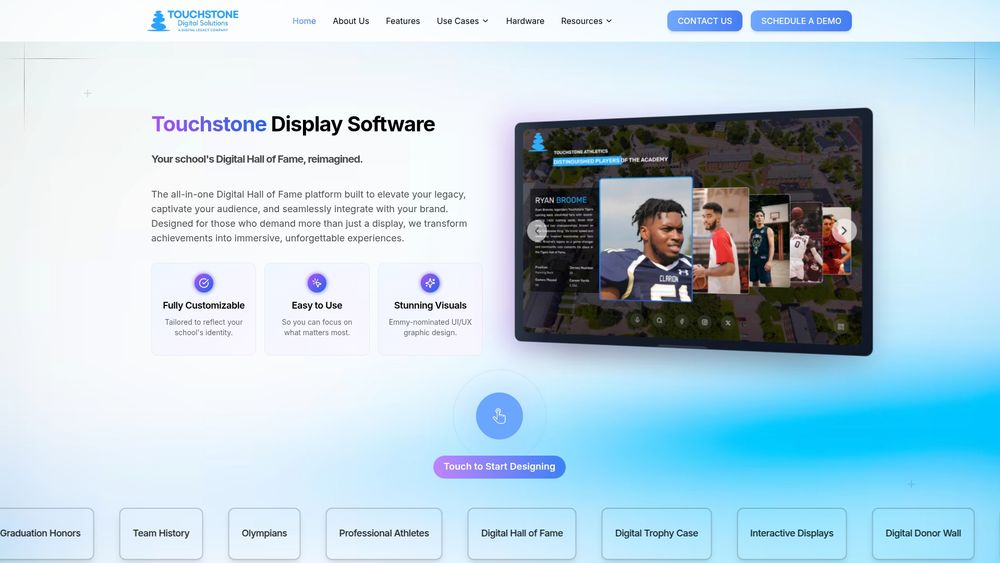
Hardware bundles are published on our site. The Wall Mounted Touchscreen Bundle and Floor Standing Touchscreen Bundle run $3,100 to $4,900 and $3,550 to $4,300 respectively, one-off. If you are ready to turn your tiers into a display, talk to our team about a design built for your school.
A simple way to get started
If you are building levels from scratch, this order saves time:
- Pull two years of giving data and find the natural clusters.
- Draft four to six tiers with round-number thresholds.
- Choose names rooted in your school’s identity.
- Match recognition to each tier: personal for all, public for mid-level, naming for the top.
- Write the policy and have your board or advancement leader approve it.
- Pick a display that can grow, and launch with a thank-you message to existing donors.
Share the new levels with your current donors before you announce them publicly. Showing them where they fit, and where the next step is, turns a policy document into a reason to give again.
FAQ
How many donor recognition levels should a school have?
Four to six is right for most schools and booster clubs. Fewer than four leaves little room to grow, and more than six makes the gaps feel small. Larger universities with major-gift programs may use eight or nine, as Montclair State does with its nine fiscal-year levels.
What should the lowest level be?
Set it at an amount most of your supporters can reach, based on your own giving data. Many schools start at $100 or less so first-time donors are included. Give that level a real name and a real thank-you, because it is where future major donors begin.
Should donor recognition levels count annual or lifetime giving?
Either works, and many institutions use both under different names. Annual tiers encourage donors to renew each year, while lifetime tiers reward long loyalty. Whatever you choose, state it plainly in your policy and on your display so donors know how they qualify.
Do donors at every level need to appear on the donor wall?
Not necessarily. Some schools list every donor above a threshold, while others show only certain tiers and thank the rest in an annual report. A digital wall makes it easier to include everyone, since adding names does not require physical space.
Who should approve naming opportunities?
Put that decision in your written policy, usually with a board, foundation committee or senior advancement leader. Setting minimum gift amounts and approval steps in advance keeps decisions consistent and protects the school if a naming ever needs to be reviewed.
Touchstone Digital SolutionsDiscuss Your Donor Recognition DisplayTalk with Touchstone about a custom digital recognition display for your school, including its design, content setup and data migration.TTouchstone Digital SolutionsEmail Touchstoneinfo@touchstone-ds.com+1( 603) 361-7541
Sources
- ADRP, Best Practices: Donor Recognition (2017)
- Montclair State University, Donor Recognition Guidelines
- WSU Foundation, Donor Recognition
- University of Wisconsin-Eau Claire Foundation, Donor Recognition
- University at Buffalo, Donor Recognition and Signage Guidelines
- University of Colorado Anschutz, Public Recognition Standards and Guidelines
- Snow College Foundation, Donor Recognition Policy
- University of Washington, Regent Policy No. 50, Naming Policy
- University of Minnesota, Board of Regents Policy: Namings and Renamings
- ADRP Midwest 2023, Donor Recognition presentation