
The best donor walls fall into a handful of types: a permanent stone or metal wall for lifetime givers, backlit panels in a high-traffic hallway, a touchscreen that tells each donor’s story, and a hybrid that combines them. Below you will find nine examples, real and illustrative, with the tier structures, placement choices and design details that separate a wall people stop to read from one they walk past.
We wrote this for school administrators, advancement officers, athletic directors and alumni offices who are planning a campaign or refreshing an old plaque wall. Use it as a menu: pick the type that fits your space, your donor count and your budget, then borrow the details.
Touchstone-dsMake School Recognition More InteractiveTouchstone helps schools turn achievements into customizable digital Hall of Fame displays that celebrate milestones and strengthen community connection.Explore Touchstone
TL;DR
- Choose the format by donor volume and giving level: physical permanence for transformational gifts, digital capacity for annual and mid-tier donors.
- Real campus examples (a university wall by a main walkway, backlit lifetime-giving panels, a museum Wall of Honor) all organize names by cumulative giving tiers.
- A digital wall lets you update names in real time, add photos and stories, and never run out of space.
- Plan placement, accessibility and the update workflow before you pick hardware.
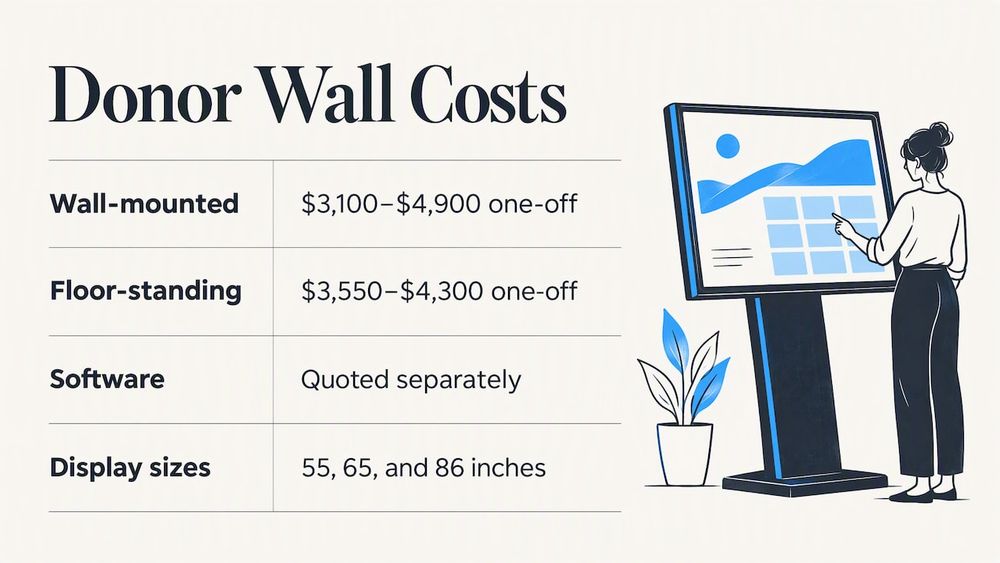
- Touchstone hardware bundles are published at $3,100 to $4,900 (wall mounted) and $3,550 to $4,300 (floor standing), one-off.
Table of Contents
- Nine donor wall examples worth studying
- Comparing the formats side by side
- Designing tiers that look good on a wall
- Design ideas that carry over to hall of fame displays
- Placement and planning checklist
- Our perspective: recognition should feel like a story, not a ledger
- What a digital donor wall costs with Touchstone
- A simple way to choose
- FAQ
- Sources
Nine donor wall examples worth studying
Every example here answers three questions: who is on the wall, where does it live, and how do names get added later? Get those right and the material and finish become the fun part.
1. The campus landmark wall
Hardin-Simmons University unveiled its Donor Wall of Honor on February 16, 2023. It stands in front of the Moody Center, overlooking campus landmarks such as the Reflection Pond, and it honors lifetime contributions. The lesson is placement. The university put its donors along one of the most traveled paths on campus instead of tucking them inside an administration building, so students, parents and visitors see the names every day.
This format suits a flagship gift or a campaign that deserves a public statement. It is permanent, and it is the kind of recognition major donors tend to picture when they think about naming.
2. The backlit lifetime-giving panel
At Loma Linda University School of Dentistry, new LED-lit panels forming a Wall of Honor were installed in a clinic waiting area to recognize lifetime cumulative giving. It is a modest, elegant setup: a wall that patients, students and faculty see while they wait.
The takeaway is that a donor wall does not need a grand lobby. A waiting area, a corridor outside the dean’s office or a student commons gives you a captive audience and a reason to read.
3. The museum or heritage Wall of Honor
A.T. Still University unveiled a Wall of Honor at its Museum of Osteopathic Medicine during Founder’s Day 2023, with guests attending the ceremony. Pairing a wall with an existing event is a smart habit. The unveiling becomes a stewardship moment, and the photos from it become content for newsletters and social media.
If your school already has a history room, trophy corridor or archive, putting donor recognition next to it connects giving to legacy.
4. The tiered plaque wall
The classic design is a grid of engraved nameplates grouped by level. It is easy to understand and it looks serious. Its weakness is capacity: every new name means a new plate, a fabrication lead time and a cost. A plaque wall works best for a closed group, such as founders of a building campaign, where the list will not grow much.
5. The donor tree or leaf wall
A sculpted tree with leaves, each engraved with a name, is a staple of elementary schools, libraries and hospitals. It is warm and affordable at small scale, and it invites smaller gifts because families can see exactly what they are buying. Plan the number of leaves in advance, though. A full tree creates an awkward conversation with the next donor.
6. The brick, tile or student-art mosaic
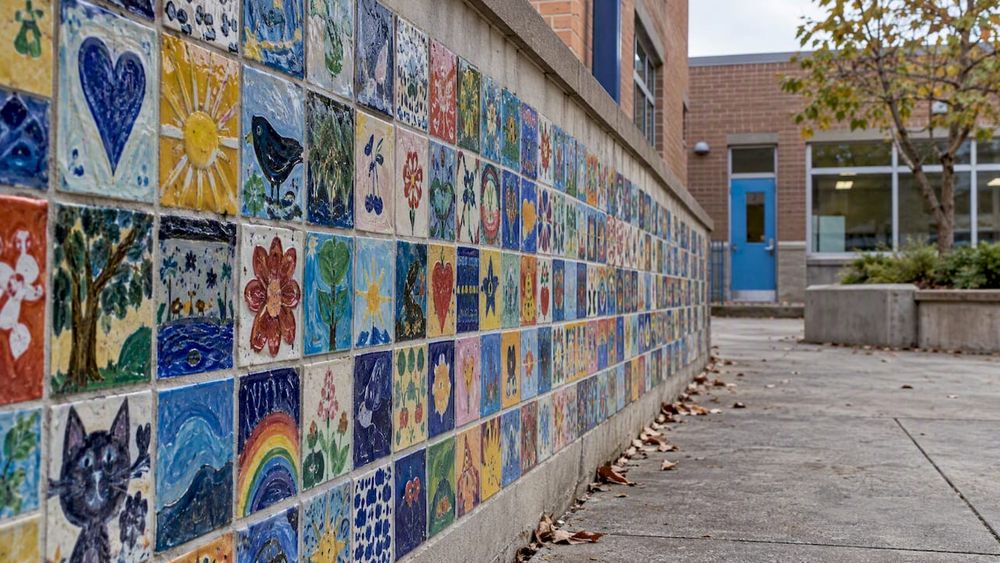
Community-built walls, where donors purchase a tile that students decorate, tie recognition to the school’s identity. They work well for a playground, courtyard or cafeteria project. Keep a master list somewhere durable, because tiles fade and walls get repainted.
7. The interactive touchscreen wall
This is the format we build. A touchscreen lets a visitor search by name, class year, giving level or campaign, then open a profile with a photo, a message, a video or the story behind the gift. The wall stops being a list and becomes a place people explore. Our article on turning donors into donor stories goes deeper on this approach.
The practical advantages are capacity and speed. Names can be added from a browser the day a gift arrives, and nothing physically runs out of room. If you are new to the idea, start with our explainer on what an electronic donor wall is.
8. The hybrid wall
Many advancement teams combine formats. Practitioners often reserve architectural, physical signage for transformational lead donors and move high-volume annual and mid-tier lists onto digital platforms, which avoids the cost of physically updating an entire wall every year.
A typical layout: a bronze or stone feature panel for the top gifts, with a touchscreen mounted beside it that includes those same top donors and everyone else. The physical piece carries the prestige. The screen carries the breadth.
9. The exterior and named-space recognition
Benches, pathways, gardens, scoreboards and named classrooms are donor recognition too. They rarely hold many names each, but they put a single name in front of people daily. Pair them with a digital wall indoors that explains each named space, and you get both permanence and context.
Comparing the formats side by side
| Format | Best for | Capacity | Updating names | Storytelling |
| Campus landmark wall | Flagship campaigns, lifetime giving | Fixed | Fabrication needed | Low |
| Backlit or plaque panel | Closed lists, building campaigns | Fixed | Fabrication needed | Low |
| Donor tree or mosaic | Small schools, community gifts | Fixed | Limited | Low to medium |
| Interactive touchscreen | Ongoing giving, large donor lists | Very large | Online, any time | High |
| Hybrid | Campaigns with lead gifts plus broad base | Large | Digital side is instant | Medium to high |
Designing tiers that look good on a wall
Tier structure drives layout, so settle it before you design anything. University stewardship programs usually segment donors by cumulative giving. For example, Loma Linda’s dental school established tiers from Patron ($25,000 to $49,999) up through Benefactor ($1 million to $4.9 million), with Founder, Ambassador and Pacesetter levels in between.
Your school does not need a six-figure ladder. A public school foundation might start at $25 or $100. What matters is a handful of clear levels, because each one needs its own visual treatment.
A few rules we share with every school:
- Use four to six levels. Fewer feels flat, more feels like fine print.
- Name levels after your school’s identity (mascot, founder, colors, a local landmark) instead of generic metals, if that fits your culture.
- Decide whether you recognize cumulative lifetime giving or single-campaign gifts, and say so on the wall.
- Give the top tier the largest type, the best position, or a featured profile.
- Set a policy for anonymous donors, memorial gifts and gifts from families or businesses.
For naming ideas, see our guide to naming donor recognition levels.
What to show for each donor
On a digital wall, each profile can hold more than a name. Typical fields include name or organization, giving level, class year, a photo, a short message, and a link to the program the gift supports. Our guide to what donor information an interactive wall should display covers privacy and consent questions to settle with your development office first.
Design ideas that carry over to hall of fame displays
Many schools ask us about donor walls and halls of fame in the same breath, and the design thinking overlaps. Both honor people. Both need a clear hierarchy, strong photography and a way to add names every year.
- Lead with a home screen that shows the school’s colors, crest and one memorable image, not a menu of text.
- Let visitors browse by category: decade, sport, giving level, or program.
- Feature a rotating spotlight so the display looks alive even when nobody is touching it.
- Keep type large. Visitors read from a few feet away, often standing.
- Use photos of real people. A face beside a name is the strongest element on any recognition display.
On legibility, the W3C’s accessibility guidance recommends a contrast ratio of at least 4.5:1 for normal text, with 3:1 for large text. A school screen is not always legally bound to the same standard as a website, but it is a sensible target for anything people must read on a dark or photographic background.
If you also want to honor athletes, a digital athletic hall of fame can live on the same hardware and software as the donor wall, so one purchase serves both programs.
Placement and planning checklist
Good walls fail for boring reasons. Run through this list before approving a design.
- Pick the location by foot traffic. Main entrances, gymnasium lobbies, performing arts centers and welcome centers all work.
- Check wall construction, power and network access for any screen.
- Choose the screen size for viewing distance. Larger spaces need larger displays.
- Decide who updates content, how often, and who approves new names.
- Plan the launch. Donor recognition should not wait until a campaign ends. Advancement consultants suggest quarterly milestone events during the campaign, such as previewing a new digital wall, to keep donors engaged.
- Decide how long recognition stays up, and tell donors up front. Our piece on how long to leave donor recognition up can help you set the policy.
If you want a step-by-step build plan, our seven-step guide to designing a digital donor wall walks through it.
Our perspective: recognition should feel like a story, not a ledger
We are a family-run company, and the founders work directly with the schools we serve. Our designers come from the gaming industry, and our interface work has been Emmy-nominated. That background shapes how we think about donor walls: a donor wall is an experience, and experiences are designed.
Here is what we believe after building these displays:
- A wall that only lists names asks people to admire it. A wall that tells stories asks them to join.
- Your school’s identity should be on every screen. A donor wall that looks like generic software feels like a vendor’s product. One that uses your colors, mascot and photography feels like yours.
- Physical and digital are not rivals. A bronze plaque for a transformational gift and a screen for everyone else is a perfectly good answer.
- Maintenance should not be a worry. Updates should happen in a browser, without a fabrication order.
The schools that get the most from their walls treat them as living programs. They add a name the week a gift arrives, feature a donor story each month, and mention the wall in thank-you notes.
— Gardner Gendron
What a digital donor wall costs with Touchstone
We publish our hardware bundle pricing so you can plan early. Our wall mounted touchscreen bundle runs $3,100 to $4,900 one-off, and our floor standing bundle runs $3,550 to $4,300 one-off. Software is quoted separately for your project. If you want to compare screen sizes, we list 55-inch, 65-inch and 86-inch displays.
When you are ready to see what yours could look like, start with our Digital Donor Walls page. We design each one around your school’s branding, and your content stays editable through cloud-based management. For more ideas first, browse the donor wall articles on our blog, or read 20+ interactive donor wall ideas.
A simple way to choose
Ask three questions:
- How many names will you have in three years? If the list will grow steadily, favor digital.
- Is there a lead donor who expects permanence? Add a physical feature panel.
- Do you want visitors to learn something about your donors? Choose an interactive display.
If you answered digital twice, a touchscreen is likely your core piece. If you answered physical once and digital twice, plan a hybrid. Digital signage practitioners agree that digital suits capacity and dynamic content, while major gifts deserve physical permanence in terms of prestige.
FAQ
What should a donor wall include?
At minimum, donor names organized by giving level, your school or program name, and the campaign or purpose it celebrates. On a digital wall you can add photos, messages, class years and videos. Whatever you show, confirm donor consent first, especially for gift amounts.
How many donor levels should a wall have?
Four to six is a practical range for most schools. Each level needs a distinct visual treatment, and too many tiers crowd the design. University programs often use more, but they also have larger donor bases and bigger gifts.
Is a digital donor wall better than a plaque wall?
It depends on your goals. Digital handles growing lists, real-time updates and storytelling, while engraved plaques offer permanence and a traditional look. Many schools use both: physical recognition for top gifts and a screen for everyone else.
Where is the best place to put a donor wall?
Put it where people already gather: the main lobby, a gymnasium entrance, a performing arts center or a welcome center. Hardin-Simmons placed its wall along a heavily used campus path for exactly this reason. Check power, network access and sightlines before you commit.
Sources
- Donor Wall of Honor Unveiled, Hardin-Simmons University
- LLUSD recognizes its donors, Loma Linda University School of Dentistry
- Wall of Honor at the Museum of Osteopathic Medicine, ATSU News
- Understanding Success Criterion 1.4.3: Contrast (Minimum), W3C
- Capital Campaign Recognition Ideas, Donors Wall
- Capital Campaign Timeline, DonorDisplay
- Education Digital Signage FAQ, Digital Signage Knowledge Base