

A good donor recognition policy is a short written document that says who approves recognition, how gift levels map to acknowledgment, what donors are promised in writing, how privacy and anonymity are handled, and how long recognition lasts. Write it before the next campaign, not during it. Schools and universities that skip this step end up making one-off decisions about plaques, names and walls, and those decisions are hard to defend later.
This guide pulls together what professional associations and real university and hospital policies say, then turns it into a plan you can adapt for a school, district foundation, athletic department or college.
Touchstone Digital Solutionscalendly.comBring Donor Recognition to LifeExplore a custom digital donor wall that brings recognition into one place, designed around your school’s colors, logo and story.Schedule a demo
TL;DR
- Put recognition procedures in writing and share them across the organization, so staff do not rely on personal judgment.
- Tie recognition to gift level, project and location, and keep it proportional and consistent rather than identical for every donor.
- Get donor consent before public recognition, honor anonymity, and proofread names with donors before anything is printed.
- State a term in every naming or gift agreement, and reserve the right to relocate or change recognition when circumstances change.
- Thank every gift quickly: professional guidance points to three business days for acknowledgment letters, and some universities allow up to 10.
Table of Contents
- What a donor recognition policy should cover
- Who approves and administers recognition
- Setting recognition levels
- Naming opportunities and agreements
- Consent, privacy and anonymity
- How long recognition lasts, and when it can change
- Keeping recognition fair and consistent
- Donor recognition etiquette: thanking supporters
- Putting the policy on display, physical or digital
- Bring your policy to life with a digital donor wall
- A starter outline for your policy
- FAQ
- Sources
What a donor recognition policy should cover
The Association of Donor Relations Professionals (ADRP) recommends written recognition procedures that are communicated across the organization, a named-spaces policy that covers giving levels and signage standards, and documentation of promises in gift or naming agreements. That gives you the backbone of a policy.
The Association of Fundraising Professionals (AFP) adds the operational detail. Its guidance says to define responsibility, timing, gift-level treatment, privacy safeguards and approval procedures in writing. The goal is consistency that does not depend on which fundraiser happens to take the call.
In practice, a complete policy has these parts:
- Purpose: recognition connects giving to your school’s mission.
- Scope: which gifts, programs, buildings and displays the policy covers.
- Roles: who proposes, who approves, who administers and who signs off on final wording.
- Gift levels: what each level earns, in print, on walls and online.
- Naming opportunities: how spaces and programs are valued and named.
- Consent and privacy: how donors opt in, opt out or stay anonymous.
- Duration and changes: how long recognition lasts and when it can be moved or removed.
- Acknowledgment: how fast and by whom donors are thanked.
- Review: when the policy is revisited.
Who approves and administers recognition
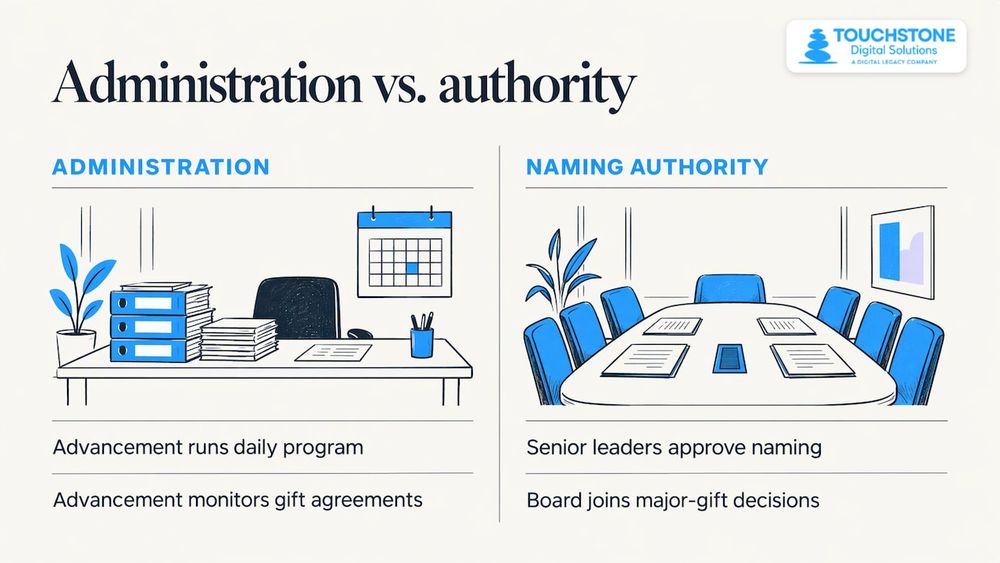
Split administration from authority. Carnegie Mellon’s naming policy is a useful model: it applies to all university naming gifts, not only those handled by the advancement office, and it places the Vice President for University Advancement in charge of approvals, in consultation with the President and Board of Trustees as appropriate.
The lesson for schools: your development or advancement office can run the program day to day, but naming authority should stay connected to senior leadership and, for major gifts, the governing board. For a K-12 school or foundation, that might mean the principal or superintendent plus the board for any naming of a building, field or gym.
The College for Creative Studies shows how thresholds work. Its policy requires naming proposals to be developed through Institutional Advancement, with proposals of $500,000 or more presented to the President and donor discussions kept provisional until approval. The University of Northern Iowa requires a written Statement of Gift Intent describing the gift, its intended use, the proposed recognition, and the fact that naming is subject to university approval.
That last point matters for small schools too. A booster club that promises a gym name over coffee has created a problem the board must later untangle. Make it a rule that nobody promises recognition before approval.
Caltech takes a complementary approach: it assigns formal written acknowledgment of all gifts to its Advancement and Alumni Relations function and says stewardship is an institute-wide responsibility, with that function monitoring compliance with gift agreements. Someone has to own the promises after the check clears.
Setting recognition levels
Levels are where policies get specific. The University at Buffalo tells staff to consider the value of the gift or commitment, the giving levels within a project, and signage location, design and aesthetics, and to consult Donor Relations before proceeding with signage. Its example room-space tiers are a good illustration of scaling: spaces valued at $1 million or more typically receive 4-inch lettering, spaces from $200,000 to $999,999 receive 2- to 3-inch lettering, and spaces under $199,999 receive a room plaque.
The College for Creative Studies lists the factors that should shape a naming level: proportion of project cost, traffic, visibility, type of use, general appeal, donor market, maturity of the donor base, comparable organizations, and creative subdivision of spaces. Texas State University adds construction or renovation and maintenance costs, operating revenue, and the donor’s total giving.
The University of Iowa notes that minimum gift levels may vary by college, discipline or program and may be adjusted for costs or campaign goals, with a committee approving levels in consultation with leadership.
For most schools, a workable method looks like this:
- List every recognition opportunity: rooms, fields, programs, scholarships, display panels, brick or paver programs, digital wall tiers.
- Assign each a value based on cost, visibility and foot traffic.
- Check that the total of opportunities is comfortably larger than the project goal, so donors have real choices.
- Write down what each tier receives, in each medium.
- Have the approving body sign off on the schedule before anyone pitches it.
For tier naming and wording, see our guide to naming your donor recognition levels.
Naming opportunities and agreements
The naming agreement is the place where policy meets a real promise. ADRP recommends documenting donor expectations in gift documentation or naming agreements. A solid agreement states the gift amount and payment schedule, the exact name and wording, the space or program, the term, and what happens if circumstances change.
Corporate gifts deserve extra care. Texas State requires corporate naming to undergo due diligence, generally uses fixed terms, excludes corporate logos from physical signage, and requires the gift agreement to specify the naming period. If you accept business sponsorships, decide in advance whether logos are allowed on displays, and apply the rule the same way every time.
Consent, privacy and anonymity
Public recognition should never be a surprise. The Bethel-Mansfield Foundation’s donor policy states that public recognition requires donor consent, that donors may remain anonymous, and that donor information is kept confidential to the maximum extent possible. Children’s Hospital Los Angeles takes a slightly different default: it honors anonymity requests unless donors change them, and may publicize contributions when no request exists. Pick one default, state it, and tell donors at the time of the gift.
ADRP adds practical advice: respect a donor’s anonymity or lack of interest in recognition, proofread naming conventions with donors before printing, budget for recognition costs, and clarify who has final sign-off.
A short consent checklist for your gift form:
- How should your name appear (individual, family, in honor of, in memory of)?
- May we list your name publicly, in print, on a wall and online?
- Would you prefer to remain anonymous?
- Who may we contact to confirm wording?
These rules apply to digital walls as much as brass plaques. A touchscreen that shows a donor’s name and story reaches more people than a plaque, so consent matters even more.
How long recognition lasts, and when it can change
Perpetual recognition is a promise most buildings cannot keep. The University of Northern Iowa states that naming lasts for the period during which the gift provides funds for its intended purpose, not automatically forever. Carnegie Mellon generally grants naming for an entity’s useful life, sets spendable-gift duration in writing and allows revocation in specified circumstances.
A sample named-space agreement from the University of Alabama at Birmingham makes naming subject to the useful life of the building, allows alternative recognition if the asset changes or a pledge is not fulfilled, and permits termination if an honoree’s activities materially conflict with the university’s mission or damage its public image.
CHLA’s policy lists the triggers plainly: recognition may be relocated or removed at the end of an agreed term, when renovations warrant a change, or when substantial changes in circumstances could compromise the organization.
Your policy should answer four questions:
- What is the standard term for each level?
- What happens at renewal or expiry?
- Under what circumstances can recognition be moved or removed?
- Who decides, and how is the donor told?
For a deeper look at term lengths on walls, read how long donor recognition should stay up.
Keeping recognition fair and consistent
Fairness does not mean everyone gets the same thing. ADRP says recognition should connect philanthropy to mission, identify the specific gift and donors accurately, and be offered in proportion to generosity. Carnegie Mellon puts it in operational terms: recognition should be equitable and consistent by gift type, amount and designation, physical recognition should be commensurate with the gift and location, and donor and university representatives must approve physical recognition before production and installation.
The National Council of Nonprofits lists timely acknowledgments, honoring donor restrictions and recognizing donors according to their preferences as accountability practices. Put those three on a card next to every fundraiser’s desk.
A few guardrails keep recognition equitable:
- Apply the same level thresholds to everyone, including board members and alumni with famous names.
- Recognize non-monetary and volunteer contributions through a separate, clearly described track.
- Check spelling, class years and affiliations before publishing.
- Review the full donor list once a year for omissions.
Donor recognition etiquette: thanking supporters
Speed and sincerity are the two rules. AFP recommends acknowledging all gifts within three business days with thank-you letters appropriate to the gift level, and says a written recognition program should define who records gifts, who acknowledges them and how privacy is protected.
The University of Washington’s guidelines take a slightly longer window: acknowledgments within 10 business days after Gift Services processes the gift, customized where appropriate, focused on appreciation and impact, and signed by an individual rather than only a department. The same guidance calls for tailored thanks for VIPs, memorial and honorary gifts, first gifts, payroll gifts and sustainers.
A simple etiquette set for schools:
- Thank within three business days if you can, and never let it slip past your stated window.
- Have a real person sign the letter.
- Name the gift and say what it will do.
- Match the gesture to the gift: a handwritten note from a coach or principal can mean more than a form letter.
- Use the name form the donor chose, including honor or memorial wording.
There is also a legal side. The National Council of Nonprofits points organizations to IRS rules, noting that written acknowledgment requirements apply to certain gifts, along with disclosure for quid-pro-quo contributions of $75 or more. Ask your finance office or counsel to confirm what your receipts must say.
Putting the policy on display, physical or digital
AFP guidance recommends recognizing supporters through events, public settings, print materials, annual honor rolls, office displays and websites while keeping clear procedures for each gift level. A policy that lists the channels makes it easier to treat donors equally across them.

Digital displays fit this model well. Names can be added the week a gift is approved, wording corrected quickly, and terms managed without re-engraving. You can also let a donor’s story sit behind the name; see how schools use interactive donor profiles to tell giving stories, and browse our digital donor wall articles for more on running a wall over time.
Whatever the format, the policy should say who approves a new name on the display, who proofreads it, how often it is updated and how a removal request is handled.
Our perspective: a policy is a promise you can keep
We build recognition displays for schools, and the best projects we see start with a clear policy, not with a screen. When you know your levels, your terms and your approval path, the design nearly writes itself.
A written policy also protects the donors you want to honor. Their names are spelled right, their wishes about privacy are respected, and their recognition lasts as long as you said it would.
This is where a digital wall earns its place. Because the content is managed in software, a new gift can be added, a correction made or a term updated without tearing out a wall. We design every display around your school’s colors, logo and story, and we work directly with your team so the display follows your policy and not the other way around.
Start with the rules, then choose the display that makes them easy to follow.
Gardner Gendron
Bring your policy to life with a digital donor wall
Once your levels, terms and approval steps are written down, a Touchstone digital donor wall lets you apply them in one place. Each display is custom-designed around your school’s colors, logo and story, and alumni can browse the same content online. We handle the full project, from hardware and content setup to staff training, with unlimited 24/7 support.
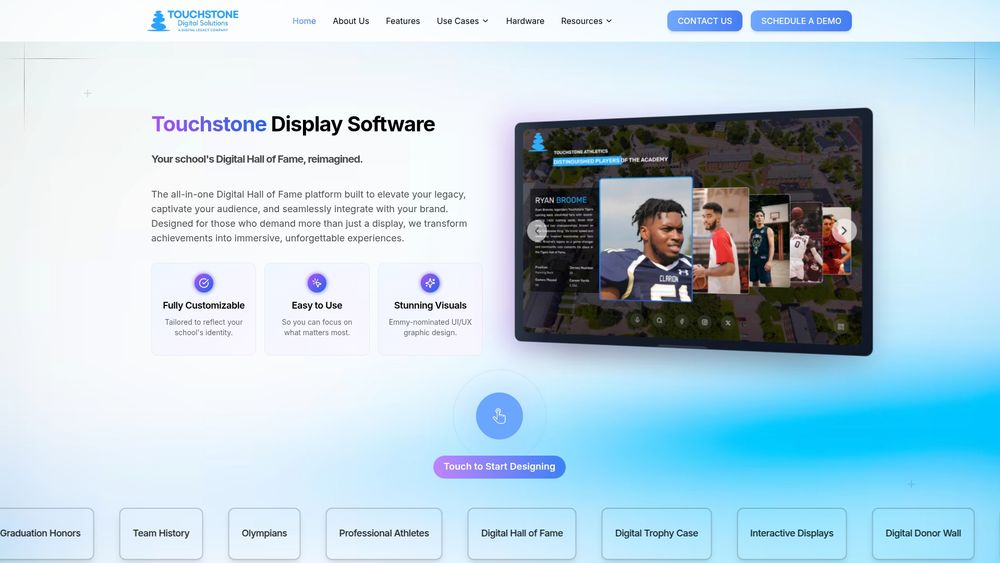
If you are planning hardware, our wall mounted and floor standing touchscreen bundles are priced at $3,100 to $4,900 for wall mounted and $3,550 to $4,300 for floor standing, as one-off prices. Our touchscreen software page explains how content is managed once the screen is up.
A starter outline for your policy
Use this as a skeleton and fill each line with your own rules:
- Purpose and scope
- Roles: proposer, approver, administrator, final proofreader
- Gift levels and what each earns
- Naming opportunities and valuation method
- Required paperwork: gift agreement or Statement of Gift Intent
- Donor consent, privacy and anonymity defaults
- Term, renewal, relocation and removal
- Acknowledgment timing and signer
- Display standards: physical and digital
- Annual review date and owner
Have your attorney and board review the draft, especially the naming terms and any language on removal.
FAQ
What is a donor recognition policy?
It is a written set of rules for how your organization thanks and publicly honors donors. It covers who approves recognition, what each gift level earns, how consent and anonymity work, how long recognition lasts and how quickly gifts are acknowledged. Its purpose is consistent, fair treatment of every donor.
How quickly should we thank a donor?
AFP recommends acknowledging all gifts within three business days. The University of Washington’s guidelines allow up to 10 business days after the gift is processed. Choose a window you can meet every time and publish it internally.
Should donor recognition last forever?
It is safer not to promise that. Policies at universities such as Northern Iowa and Carnegie Mellon tie naming to the gift’s funding period or the useful life of the entity, and hospital and university examples reserve the right to relocate recognition after renovations. State the term in the gift agreement.
Do donors have to agree to public recognition?
Best-practice and policy examples say yes. Donors should be asked, and anonymity requests honored. Proofread the exact wording with the donor before anything is printed or published.
Who should approve naming gifts at a school?
Advancement or development staff can administer the process, but major naming should be approved by senior leadership and, where appropriate, the board. Many universities set a dollar threshold above which the president or board must sign off.
Touchstone Digital SolutionsDiscuss Your Donor Recognition DisplayTalk with Touchstone about a custom digital donor wall and the content, hardware and design options for your school.TTouchstone Digital SolutionsEmail Touchstoneinfo@touchstone-ds.com+1( 603) 361-7541
Sources
- ADRP, Best Practices in Donor Recognition (2017)
- AFP, Developing Fundraising Policies and Procedures
- Carnegie Mellon University, Naming Gifts policy
- University at Buffalo, Donor Recognition and Signage
- College for Creative Studies, Donor Naming Opportunities
- University of Iowa, Joint Development Committee Guidelines on Naming
- Texas State University, UPPS 08.03.01 Criteria for Namings
- University of Northern Iowa, 8.03 Naming
- Children’s Hospital Los Angeles, Donor Confidentiality and Privacy Policy
- Bethel-Mansfield Foundation, Donor Policy
- University of Alabama at Birmingham, sample named space gift agreement
- University of Washington, Guidelines for Gift Acknowledgments
- National Council of Nonprofits, Ethical Fundraising
- California Institute of Technology, Gift Policies