
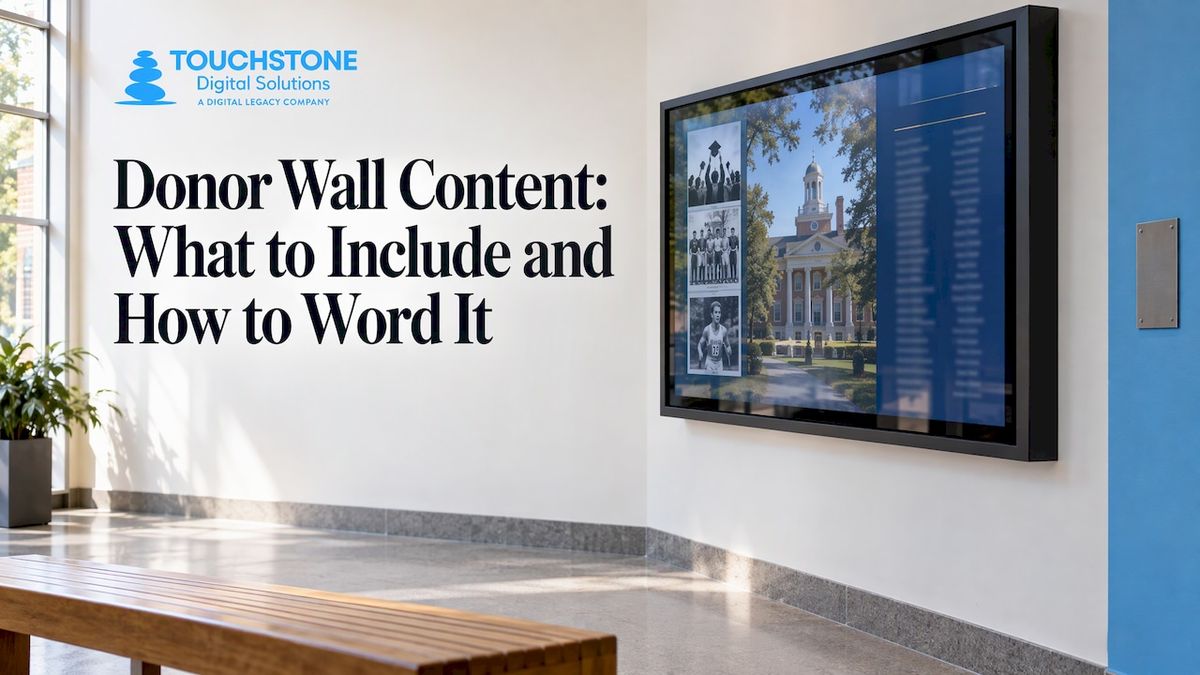
Good donor wall content comes down to four decisions: who you list, how you word each name and dedication, how you group gifts, and how you keep the display accurate after launch. Settle those on paper before anyone picks a frame, a screen or a font. A digital display makes the last decision far easier, because a name can be added or corrected without rebuilding the wall, and our digital donor walls are built around that idea.
This guide is for school, university and athletic program staff who have to fill the wall, not design it. It covers what to put on it, how to phrase it, and how to avoid the mistakes that are painful to fix once a name is misspelled in public.
Touchstone Digital Solutionscalendly.comKeep Donor Recognition CurrentTouchstone creates custom digital donor walls that schools can update, with content setup and data migration handled as part of the project.Schedule A Demo
TL;DR
- Start with a written recognition policy that says who is listed, at what level and for how long. Professional donor relations guidance asks for exactly that.
- Keep each entry simple: the donor name as the donor approved it, the giving level, and a short line that states the intent of the gift.
- Use consistent wording rules: “and” instead of “&,” the same name order every time, and clear phrases such as “In memory of” and “By.”
- Confirm every name and every story with the donor (or a family representative) before it goes on display.
- Choose a format you can update, so the wall never shows last year’s donors.
Table of Contents
- Start with a policy, not with names
- What information belongs on a donor wall
- How to word donor names
- Dedication wording: what to say and how to say it
- Organizing donors by level without losing the personal touch
- Confirm, approve and protect: the content workflow
- Why digital content ages better
- Putting your content on a Touchstone display
- Our perspective
- FAQ
- Sources
Start with a policy, not with names
Before you collect a single name, write down why and how donors are recognized. The Association of Donor Relations Professionals (ADRP) says in its 2017 best practices for donor recognition that organizations should adopt written policies explaining how and why donors are recognized, so that recognition is fair across the institution and stewardship stays consistent. The same document describes recognition as a stewardship tool that carries the organization’s voice and shows the link between giving and the mission.
For a school, that policy answers the questions that otherwise come up in the middle of a campaign:
- Which gifts qualify for the wall: cash, pledges, in-kind gifts, gifts through a booster club?
- What is the minimum level for display?
- Are alumni, parents, businesses, foundations and memorial gifts all listed together or in separate groups?
- How long does a name stay up?
- Who approves exceptions?
If you need help building this, our guide to donor recognition policies for schools walks through the pieces, and our article on how long recognition should stay up covers the duration question.
The ADRP also notes that campaign recognition is additive to an existing program and should follow a formal strategy that manages donor expectations at different gift levels. In practice, that means a capital campaign wall should be planned alongside your ongoing annual giving recognition, not instead of it.
What information belongs on a donor wall
The content of a donor wall is smaller than most committees expect. A strong entry usually has three layers, and which layers you use depends on the size of the gift and the format.
The core layer: every donor
- The donor’s name, exactly as the donor wants it displayed.
- The giving level or society the donor belongs to.
- The campaign, fund or program the gift supports, when relevant.
That is enough for a name-only listing, and for most annual donors it is the right amount.
The context layer: leadership and named gifts
- A one- or two-line dedication, such as who a gift honors or remembers.
- The year or campaign of the gift.
- The space, scholarship, program or team the gift named.
This is where wording matters most, and the next sections cover it in detail.
The story layer: where a digital display earns its keep
- A short biography or reason for giving, in the donor’s own words when possible.
- A photo of the donor, the person being honored or the space that was named.
- For alumni, a class year, team or activity, so visitors can connect the person to your school’s history.
- For athletic programs, a link between the donor and the program, such as a team they played on or a facility their gift built.
A printed plaque has no room for a story layer. A touchscreen does, and it lets visitors search for a name or a class year. Anything you write for this layer should be reviewed and approved by the benefactor before it appears. CU Anschutz’s public recognition standards state that content written about a benefactor should be reviewed and approved by the benefactor or, if deceased, a trusted representative, before display or publication. That is a sound rule for a school of any size.
How to word donor names
Names are the most visible content on the wall and the easiest to get wrong. Decide on a style and write it down. University donor relations offices publish their style rules, and they show the kinds of decisions you will face.
The Penn Medicine donor recognition style guidelines recommend:
- Listing couples without “Mr.” or “Mrs.”
- Including middle initials.
- Using “and” rather than “&.”
- Cross-checking organization and foundation names against the donor database and the web.
Your own rules can differ, and some institutions’ do. The University of Virginia’s donor recognition guidelines, updated in July 2025, say area dedications should leave out middle names and initials. They also list a married pair with the woman’s name first, except when only one of the two is an alumnus, in which case the alumnus comes first. Penn Medicine places the male name first. Neither is the single correct answer. What matters is that you pick one rule and apply it to every entry.
A short style sheet for your wall might cover:
- Name order for couples and for donors with different last names.
- Whether to include middle initials, suffixes (Jr., III) and titles (Dr., Coach).
- How to list businesses, foundations and family funds, including exact legal or preferred names.
- How to list classes and teams (“Class of 1994,” “1998 State Champion Softball Team”).
- How to display anonymous donors.
- Which spelling and accent marks to preserve.
The rule behind all of it: the donor’s stated preference wins, and your style sheet handles everyone who has no preference.
Dedication wording: what to say and how to say it
Dedication lines are short, so every word has to carry the donor’s intent. The Penn guidelines point out that dedication wording should make clear what the gift does and who it honors. “In memory of” identifies the person being remembered, while “By” identifies the donor. If you leave out those small words, a visitor can read a memorial as a gift from the person who died.
Here are templates you can adapt. Fill the brackets with details the donor has approved.
Memorial gifts
- In memory of [Name], [Class of year]
- The [Name] Memorial Scholarship Fund, established by [Donor name]
Honor gifts
- Named in honor of [Name], who taught [subject] at [School] from [year] to [year]
- In honor of the [Year] [Team name]
Naming gifts
- The [Name] Family Athletic Training Room
- [Space name], a gift of [Donor name]
Group and campaign gifts
- The Class of [year], in celebration of our [anniversary] reunion
- With gratitude to the families of [School] Boosters for [campaign name]
The Penn guidelines recommend organizing lists by giving circle or tier and following naming conventions the donor has approved. Keep dedication lines to one sentence where you can. Save the longer storytelling for the digital layer, where visitors choose to read it instead of squinting at a plaque.
Organizing donors by level without losing the personal touch
Giving levels are how most walls are organized, and they are also where a display can start to feel like a price list. Three habits keep it personal.
Name your levels. A level called “Founders Circle” ages better than one called “$10,000 and above,” because a dollar threshold looks dated when your costs rise and your thresholds change. Our articles on setting donor recognition levels that work and naming your giving tiers go through examples.
Set thresholds with a reason. Texas State University’s naming opportunity toolkit says its naming gift values reflect construction or renovation and ongoing maintenance costs, program prominence and visibility, operating revenue, and comparable opportunities at the university or peer institutions. A school does not need a formula that complicated, but the principle holds: be able to explain why a space or level costs what it does.
Give every level a place. Smaller donors should not disappear. A searchable list of all donors, alongside featured stories for leadership donors, lets a $50 gift and a $50,000 gift both be found, which keeps the wall inclusive.
Confirm, approve and protect: the content workflow
The best wording still fails if the facts are wrong. Build these checks into the process.
Check names against your records
Penn’s guide notes that donor names were checked against its records and reviewed for accuracy, and that gift officers review gift agreements for recognition preferences. Do the same: start from your database or gift agreement, not from a mailing list or last year’s wall.
Document naming gifts
Texas State uses gift agreements or memoranda of understanding to document naming opportunities. It requires board approval where applicable, and donor confirmation before public announcements or signage. If a gift names a building, field or room, put the exact wording and duration in writing first.
Proof with the donor
The ADRP guidance says to respect a donor’s preference for anonymity or limited public exposure, and to proof all names and conventions with the donor before finalizing a print or display. Send each donor exactly what will appear and ask for a yes. Record the answer.
Decide who approves design
If your project is part of a facility build, know who signs off. Rutgers Athletics’ donor recognition guidelines say the architect or selected design firm creates the donor wall design, and the client, the Foundation, and Planning, Development & Design review it. A smaller school may have fewer reviewers, but naming them before design starts avoids late changes.
A simple content checklist
- Policy approved and written.
- Names pulled from the gift records.
- Style sheet applied to every entry.
- Dedication lines drafted using intent words (“In memory of,” “In honor of,” “By”).
- Stories and photos approved by the donor or representative.
- Anonymity and display preferences recorded.
- Final proof sent to each named donor.
- Update schedule and owner assigned.
Why digital content ages better
A physical wall freezes your content on the day it is made. Adding a new donor means ordering a new plate, and a donor who moves up a level can’t move up the wall without rework. Texas State’s toolkit goes so far as to recommend against building new donor walls, and says that if one is necessary a digital display is the better choice, since physical walls are costly and time-consuming to update and go out of date when a new donor reaches the recognition level.
For your content plan, that changes a few things:
- You can launch with the donors you have, then add names as gifts arrive.
- You can correct a spelling the same day it is reported.
- You can feature different donors or stories through the year.
- You can keep a full history of past campaigns in one place instead of removing old walls.
If you are weighing formats, our donor wall examples article shows nine designs and what makes each one work, and our guide on what donor information to show on an interactive wall goes deeper on the fields.
Putting your content on a Touchstone display
Gathering and writing the content is usually the slow part of a donor wall project. Touchstone Digital Solutions handles the full project: commercial touchscreen hardware, custom wall wraps, content setup and data migration. Every display is custom-designed around your school’s colors, logo and story, with accessibility built to ADA (WCAG 2.1) standards. Content is managed in the cloud with real-time updates, and alumni can browse the same content online.
Touchscreen hardware bundles are published at $3,100 to $4,900 for a wall mounted bundle and $3,550 to $4,300 for a floor standing bundle, one-off. Software and donor wall pricing is quoted for your project. You can see the options on our touchscreen hardware page, or start with the digital donor walls page.
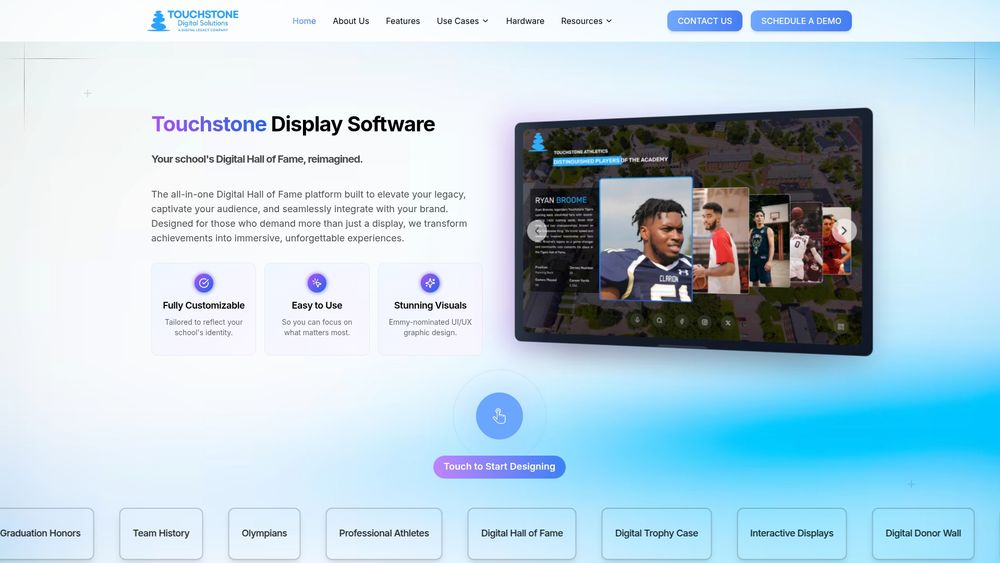
We also provide staff training and unlimited 24/7 support, and more than 350 schools and organizations use our displays. If your donor wall will sit next to other recognition, the same platform covers digital trophy cases, record boards and an athletic hall of fame, so your donors, athletes and alumni live in one place.
Our perspective
We are a family-run company, and we build recognition displays because we believe people should be thanked in a way that reflects who they are. A donor wall is not a list of transactions. It is the place where a school says, in public, that someone’s generosity mattered.
That is why we argue for putting the content first. The wording, the approvals and the stories are what a visitor remembers, and the display should make them easy to present and easy to keep current. Our designers come from the gaming industry and our work has been Emmy-nominated, and we put that effort into making a school’s own colors, logo and story the center of every display.
A digital wall also fits how schools actually work. Donors give year after year, classes celebrate anniversaries, and a gift that names a space should be on the wall the week it is announced. With real-time updates and cloud-based content management, your team can keep the wall as current as your giving. We work directly with schools from the first content conversation through training, because a wall your staff can maintain is a wall that keeps honoring donors.
Gardner Gendron
FAQ
How much text should each donor entry have?
Most donors need only a name and a level. Add a one-line dedication for named or memorial gifts, and reserve longer stories and photos for leadership donors on a digital display, where visitors can choose to read more.
Should donor walls list gift amounts?
Usually not. Named levels age better than dollar figures, because amounts and thresholds change over time. Display the level or circle, and keep the exact gift amount in your records.
How do I handle donors who want to stay anonymous?
Record their preference in the gift agreement and follow it. The ADRP’s best practices say to respect a donor’s wish for anonymity or limited public exposure. You can list an anonymous donor as “Anonymous” within the proper level, or leave the name out, depending on what the donor chooses.
Who should approve the final wording?
The donor, or a trusted representative if the donor has died, should approve any story or dedication about them. Your advancement or development office should also sign off on the style, and any naming gift should follow the approval steps in your gift agreement.
What if a name is wrong after the wall goes up?
Correct it right away and tell the donor. On a digital display, the fix is an edit instead of a new plate, which is one reason digital content is easier to keep accurate.
Touchstone Digital SolutionsDiscuss Your Donor Wall ContentReach out to talk about recognizing donors with a custom digital display designed around your school’s colors, logo and story.TTouchstone Digital SolutionsEmail Touchstoneinfo@touchstone-ds.com+1( 603) 361-7541
Sources
- ADRP Best Practices for Donor Recognition (2017)
- Penn Medicine Donor Recognition Style Guidelines
- University of Virginia Donor Recognition Guidelines (2025)
- Texas State University Naming Opportunity Toolkit
- CU Anschutz Public Recognition Standards and Guidelines
- Rutgers Athletics Donor Recognition Guidelines