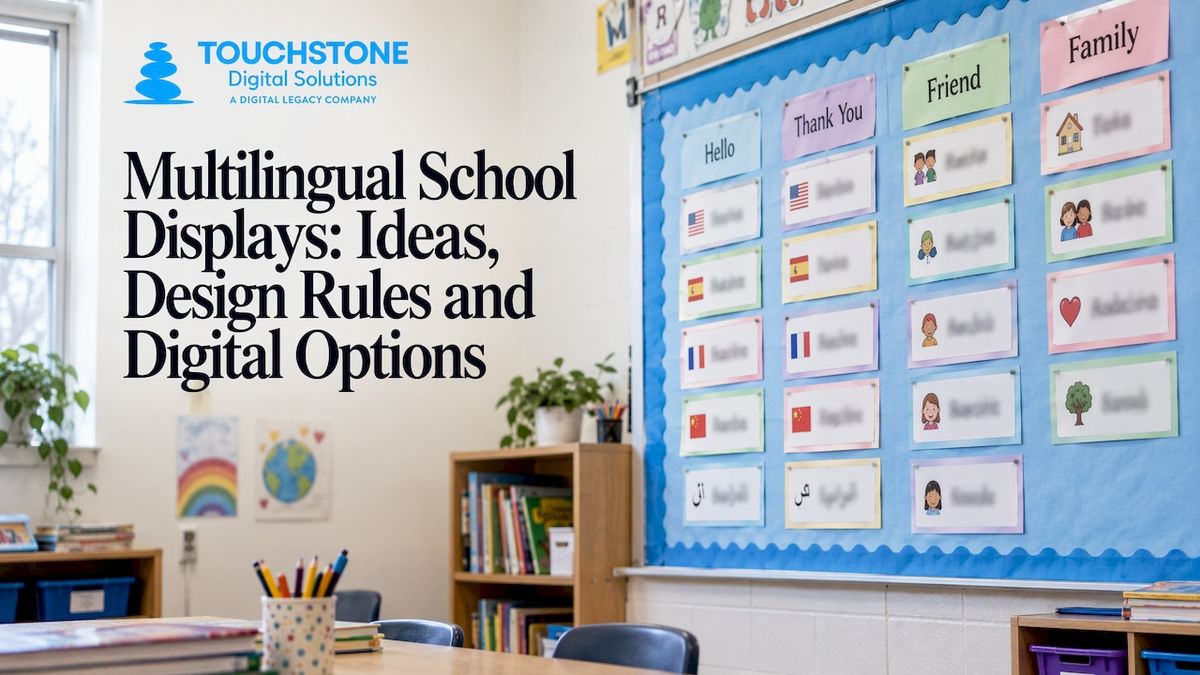
A good multilingual school display shows every student’s language as part of the school’s identity, not as a poster tucked into one classroom. Build it with students and families, give each language equal size and quality, and refresh it all year. For a lobby, hallway or recognition wall that has to stay current, a custom touchscreen display lets you add new stories without reprinting anything.
This guide is for administrators, athletic directors, alumni offices and educators who want to honor achievement and belonging at the same time. It covers what the research and official guidance say, what to put on the wall, how to design the text, and where digital displays fit.
Touchstone Digital Solutionscalendly.comBring More School Stories TogetherCreate a custom touchscreen display that brings school history and recognition into one place, with content alumni can also browse online.Schedule A Demo
TL;DR
- Multilingual displays work when students see themselves in them. Official guidance from NYC Schools says inclusive visuals send a clear message: everyone belongs.
- Give home languages equal footing with English: same size, same quality, same placement.
- Involve families and students in the content. Their words, photos and stories are what make a display feel real.
- A display only helps if it stays alive. Plan a refresh rhythm before you hang anything.
- Think school-wide, not only classroom walls: lobbies, hallways and recognition spaces send the strongest signal to visitors.
Table of Contents
- Why multilingual displays matter in U.S. schools
- What a multilingual display actually is
- What to include in a multilingual display
- How to involve students and families
- Design rules for text that is accurate, readable and welcoming
- Keeping displays alive all year
- Taking multilingual recognition beyond the classroom wall
- Where each type of recognition display fits
- A starter plan you can follow this semester
- Perspective
- Bring your school’s whole story into one place
- FAQ
- Sources
Why multilingual displays matter in U.S. schools
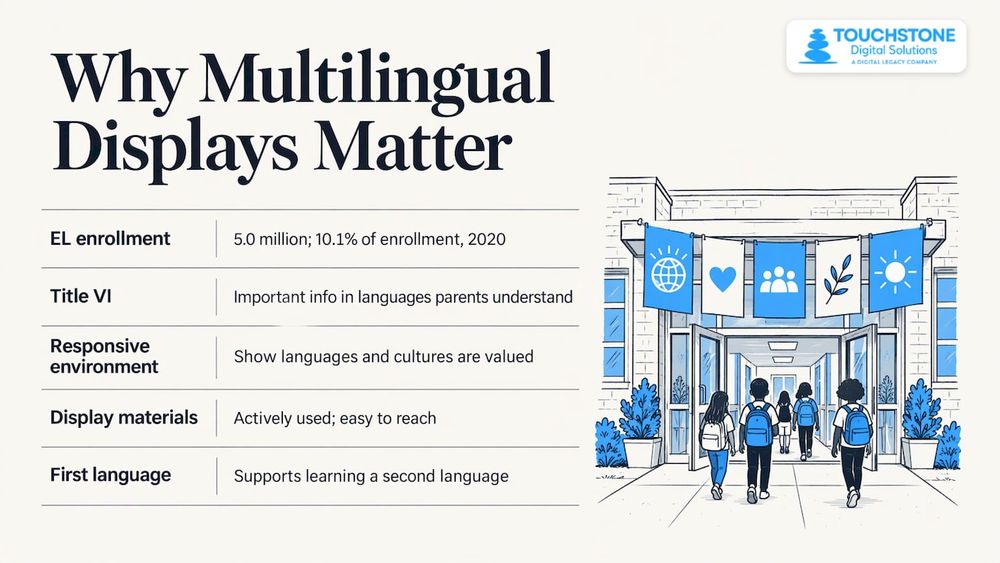
The scale alone makes this a whole-school issue. According to the National Center for Education Statistics, about 5.0 million public school students were English learners in fall 2020, roughly 10.1 percent of enrollment. In some states the share is higher, and many more students speak another language at home without being identified as English learners.
Federal civil rights guidance also sets expectations for communication. The U.S. Department of Education explains that Title VI requires schools to communicate with limited English proficient parents about important school information in languages they can understand. A display is not a substitute for that duty, but it is the first thing a family sees when they walk in, and it tells them whether the school expects them.
The learning case is just as practical. The Multilingual Learning Toolkit says a culturally and linguistically responsive environment should show multilingual children that their languages and cultures are valued and let them see themselves in the room. The same source adds a condition worth remembering: materials must be actively used in instruction and easy to reach, not just present.
There is a developmental reason too. A strong first language supports the second one, a point Valentina Gonzalez makes in Edutopia, countering the belief that more English at home produces more English. If you want a deeper look at why early language foundations matter, this overview of language development in early childhood is a good starting point.
What a multilingual display actually is
The term covers more than a “hello” poster. Buffalo City School District’s guide to building a multilingual ecology defines it as an environment that treats linguistic and cultural differences as assets and connects students’ prior experiences to the curriculum. A display is one visible piece of that ecology.
Think of three levels:
- Classroom displays: labels, word walls, charts and student work.
- Building displays: welcome signs, hallway boards, bulletin boards and posted expectations.
- Recognition and heritage displays: halls of fame, trophy cases, record boards, donor walls and history archives that tell the school’s story.
Most advice online stops at level one. The schools that make the biggest impression work across all three.
What to include in a multilingual display
The Buffalo guide gives a long, practical list for classrooms. The most useful items:
- Multilingual labels on classroom library baskets, supplies, common areas and math manipulatives
- Word walls with words, images, definitions or example sentences
- Dictionaries and glossaries in students’ home languages
- A calendar of multicultural holidays
- Alphabet and number charts in different languages
- Maps, flags, coins and stamps from other countries
- Newspapers and magazines in different languages
For the whole building, the same guide recommends welcome signs translated into all students’ languages, bulletin boards that reflect every culture and language in the school, multilingual greetings from staff, morning announcements in different languages, and rules and expectations posted in several languages.
The New York State Education Department’s resource guide for working with multilingual learners (November 2025) adds an idea that often gets missed: show the multicultural lens students used to study a topic, and carry displays about the multiculturalism in your classrooms out into the wider school.
Start with the languages you actually have
NAEYC advises teachers to find out which languages their students speak and focus the setup on supporting those languages. A survey at enrollment, a quick family form or a conversation with your ESOL team gives you the list. Build for the languages in your building first, then widen.
Pick the first words carefully
NAEYC suggests learning 10 to 20 key words in each child’s home language, and its starter list is practical: hello, my name is, eat, drink, hurt, bathroom, wash your hands, help, yes and no. Those same words make strong first labels and wall signs, because they help a new student navigate the day.
How to involve students and families
The top-ranking pages for this topic agree on one point: families should contribute, not just receive. The evidence supports it.
- Ask families to send photos of foods, celebrations and activities that matter to the child, and to help label them in English and the home language. NAEYC recommends this for personalized posters, displays and class books.
- Run an “All About Me” activity in the first week. Buffalo’s guide describes students making displays with their picture, birth country or flag, language spoken and a self-description, and posting them all year.
- Try identity texts. The NYSED guide describes students creating a text in English and their home language to share their cultural and linguistic identities, in writing, speech, art, music or a mix.
- Invite families in. Learning for Justice recommends inviting families to share their cultures, stories and experiences in class or at school events.
- Collect environmental print. Scholastic’s tip sheet proposes a class collage where students gather print from home and the neighborhood, such as signs, packaging and flyers, and the teacher turns it into a collage or booklet for everyone.
A practical note on accuracy: online translation tools are a fine starting point, and NAEYC mentions them, but it also recommends asking parents to help with specific words for schedules and topic displays. Have a fluent speaker read every label before it goes up.
Design rules for text that is accurate, readable and welcoming
The NISE Network’s Bilingual Design Guide was written for museum exhibits, but its principles apply to any public display. Four rules carry over directly.
- Give both languages similar presence. The Multilingual Learning Toolkit’s example is simple: make labels the same size in both languages.
- Write concisely. Stick to essential concepts, and where you can, let an image carry the meaning.
- Keep quality equal. The NISE guide says the experience in both languages should have the same quality, integrity and perceived importance.
- Review with bilingual staff or families before you finish.
Two more habits help. First, show home cultures positively: books and materials should depict students’ backgrounds in a positive light. Second, resist clutter. Gonzalez cautions in Edutopia that too much decoration can distract learners, so give each display one clear job.
A quick checklist before you hang anything
| Check | What good looks like |
| Language order | No language is always on top or always smaller |
| Font and size | Same typeface family and size across languages, readable from several feet away |
| Accuracy | A fluent speaker reviewed every label |
| Purpose | The display supports a lesson, a routine or a welcome, not just decoration |
| Ownership | Students or families helped create it |
| Refresh plan | Someone owns the update date |
Keeping displays alive all year
Static displays fade into the wallpaper. The Kapor Foundation notes that word walls can run all year or change with each unit, and gives 5 to 7 new words per week as a general guideline, along with teaching students to treat the wall as a learning resource.
Seasonal and thematic boards keep interest up. The TPT Blog’s fall bulletin board ideas include a board of Spanish and English greetings, flags colored by students and Día de Los Muertos art. A Rice University teaching blog describes a country board that grows over a month as students study a place, adding people, words and graphics, and learn to say hello and goodbye in the local language.
A simple yearly rhythm works well:
- August and September: welcome signs, “All About Me” displays, label routines
- Each unit: a refreshed word wall or chart in the languages in the room
- Heritage months and school events: feature families and community members
- Spring: a showcase where students present their identity texts to the school
Taking multilingual recognition beyond the classroom wall
Classroom boards reach the students in the room. Lobbies, hallways and gyms reach everyone: families at pick-up, visiting teams, alumni at homecoming, prospective parents on a tour. That is where a school’s values are most visible, and it is also where recognition displays already live.
Most schools honor achievement in the same places: trophy cases, record boards, hall of fame plaques and donor walls. Those displays tell visitors who the school celebrates. If every name and story on them comes from one slice of the community, the message is narrower than you intend. Widening the stories you collect, and giving families a way to contribute them, is one of the most effective ways to make a school’s whole-building story match the students in it.
Printed recognition has a built-in problem here. A plaque is expensive to change, so stories get added once a year at best, and new graduates, new records and new families wait. Our lobby display ideas and digital hall of fame ideas show how schools turn these spaces into something that grows.
What a digital display changes
A touchscreen display holds far more than a wall can. Student profiles, photos, team histories, records and archived yearbooks can sit in one place, and visitors browse by touching. Touchstone’s platform uses cloud-based content management with real-time updates, so adding a new story does not mean a new print run. Alumni can also browse the same content online, which extends the display beyond the building.
Accessibility matters in a building that serves many families. Touchstone builds its displays to ADA (WCAG 2.1) standards. For web content, W3C’s guidance on language of page is part of that accessibility conversation: it exists so assistive technology can tell what language a page is in.
Our own blog covers how schools use interactive touchwalls and what school digital signage can do for a campus.
Where each type of recognition display fits
If you are planning around recognition, match the display to the story you want to tell.
| Goal | Display |
| Celebrate athletes across decades | Digital Athletic Hall of Fame |
| Keep records current the day they fall | Digital Record Boards |
| Showcase team trophies and awards | Digital Trophy Case |
| Thank supporters and donors | Digital Donor Walls |
| Preserve the school’s past | Digital History Archive |
| Bring old yearbooks to life | Professional Yearbook Digitization |
For academic recognition, our list of achievements to feature on an academic wall of fame helps you decide whose stories belong. Schools honoring many kinds of success, not only athletics, tend to reach more families.
A starter plan you can follow this semester
- Map your languages. Survey families and check with your ESOL or bilingual staff.
- Choose three spaces: one classroom, one hallway, one high-traffic area such as the lobby.
- Collect content with families: photos, greetings, short stories, labels.
- Have fluent speakers review every word.
- Design with equal weight for each language, concise text and strong images.
- Assign an owner and a refresh date for every display.
- Add a recognition layer: decide which student, alumni and community stories your trophy case, hall of fame or history wall should tell.
Perspective
We build recognition displays for a living, and the pattern we see in the design process is simple: a school’s story is bigger than its trophy case.
Every school we work with starts with the same question, who gets remembered here? The answer changes when the school gathers stories from the whole community, not just the records that were easy to engrave. A display that reflects every student is not a nice extra. It is the honest version of the school’s history.
That is why we design each display around the school’s own colors, logo and story, and why we keep content easy to update. A wall that can grow with every graduating class, every new record and every family’s contribution never goes stale. Our team handles the hardware, wall wrap, content setup and data migration, then trains your staff and supports you around the clock, so the work of gathering stories stays with the people who know them best.
Recognition inspires pride when students can see themselves in it. Build toward that.
Gardner Gendron
Bring your school’s whole story into one place
Touchstone Digital Solutions is a family-run company in Bedford, NH. We design interactive recognition displays for schools, universities, athletic departments and community organizations, and more than 350 schools and organizations use them. Each display is custom-designed around your colors, logo and story, and we handle the commercial touchscreen hardware, custom wall wraps, content setup and data migration, plus staff training and unlimited 24/7 support.
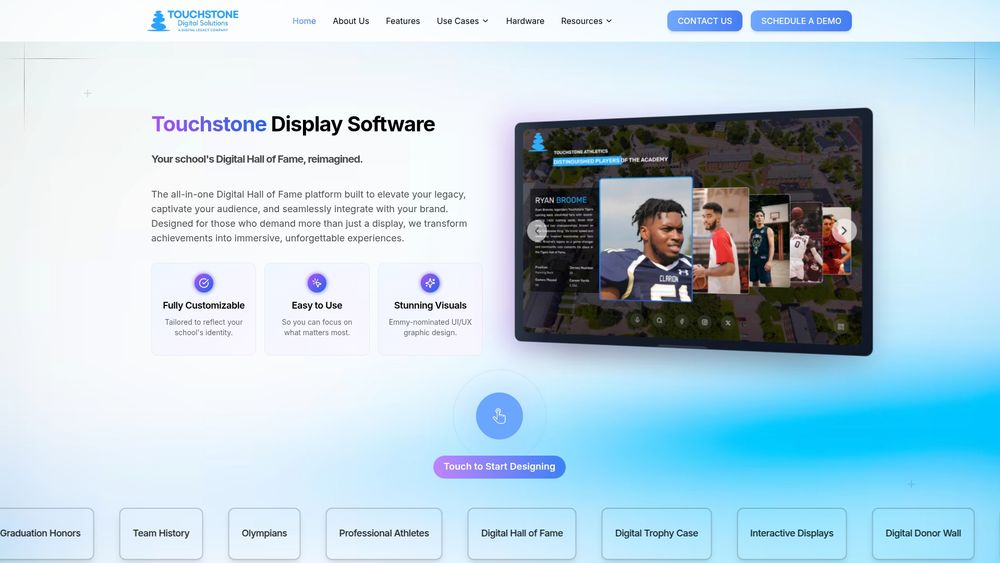
Our published hardware bundles run from $3,100 to $4,900 for the wall mounted option and from $3,550 to $4,300 for the floor standing option, as listed on our touchscreen hardware page. Software and display packages are quoted to the project. To see what a display could look like in your lobby, start at touchstone-ds.com.
FAQ
What should a multilingual school display include?
Start with the languages your students and families actually speak. Add welcome signs, labels for common spaces, word walls and greetings, then layer in student and family stories. Official guidance such as Buffalo City School District’s multilingual ecology guide also recommends posting rules and expectations in several languages.
How do I keep the translations accurate?
Use a translation tool only as a first draft, then ask a fluent family member, staff member or bilingual colleague to review every label. NAEYC recommends asking parents to help with specific words for schedules and topic displays. Review before printing or publishing, not after.
How often should a multilingual display be updated?
Tie updates to a natural rhythm: each unit, each season or each heritage month. A classroom word wall can change weekly or by unit, with 5 to 7 new words a week as one general guideline. Hallway and lobby displays work well on a term or semester refresh, and digital recognition displays can be updated whenever new content is ready.
Do multilingual displays really help students learn?
The Multilingual Learning Toolkit says materials that let multilingual children see themselves help most when they are actively used in instruction and easy to reach. So connect each display to a lesson, routine or family event. A display that students and families helped create is more likely to be used.
Can a digital display work for recognition and belonging together?
Yes. A touchscreen display can hold many student, alumni and program stories in one place, and cloud-based updating means new content can be added as it is collected. That makes it a natural home for a school’s full history, from athletics to academics to community contributions.
Touchstone Digital SolutionsTalk About Multilingual RecognitionShare your ideas for a school display and learn how Touchstone creates custom recognition experiences for schools and their communities.TTouchstone Digital SolutionsEmail Touchstoneinfo@touchstone-ds.com+1( 603) 361-7541
Sources
- Fast Facts: English learners, NCES
- Equal Education Opportunities for English Learners, U.S. Department of Education
- Classroom Environment, Multilingual Learning Toolkit
- Using English Learners’ Primary Language in School, Edutopia
- Creating Multilingual Ecologies, Buffalo City School District
- Welcoming and Inclusive Schools for Multilingual and Immigrant Communities, NYC Schools
- Resource Guide: Working with MLLs/ELLs, NYSED
- Welcoming Dual Language Learners, NAEYC
- Best Practices for Serving English Language Learners and Their Families, Learning for Justice
- NISE Network Bilingual Design Guide
- Word Wall, Kapor Foundation
- Fall Bulletin Board Ideas, TPT Blog
- Understanding SC 3.1.1: Language of Page, W3C